Updated July 27, 2026

3D Roofs Editorial Team
Editorial Standards
If your Colorado roof took a hit, the right answer is usually simple: repair isolated damage, replace widespread damage, and let age and local weather break the tie. That matters here because Colorado roofs fail where the weather hits hardest, and hail leads the list. Spring and summer storms along the Front Range drive granule loss, bruising, and outright punctures. High winds can peel shingles and underlayment off edges and ridges. Intense sun at altitude, snow load, freeze-thaw movement, and wildfire exposure can all shorten the life of the system. Your decision should be based on what actually failed, how much of the roof is affected, and whether a repair still leaves you with a roof you can count on.
Should you repair or replace a roof in Colorado?
Repair is usually the better move when the damage is limited to one area and the rest of the roof is still in solid shape. Replacement is usually the better move when damage is spread across many slopes, when the roof is already aging out, or when a repair would only postpone a larger problem. In practical terms, a small section with a few missing shingles, lifted ridge pieces, or localized flashing damage often points to repair. A roof with repeated leaks, hail marks across multiple elevations, widespread granule loss, brittle shingles, or visible soft spots usually points to replacement.
How do you tell if roof damage is isolated or widespread?
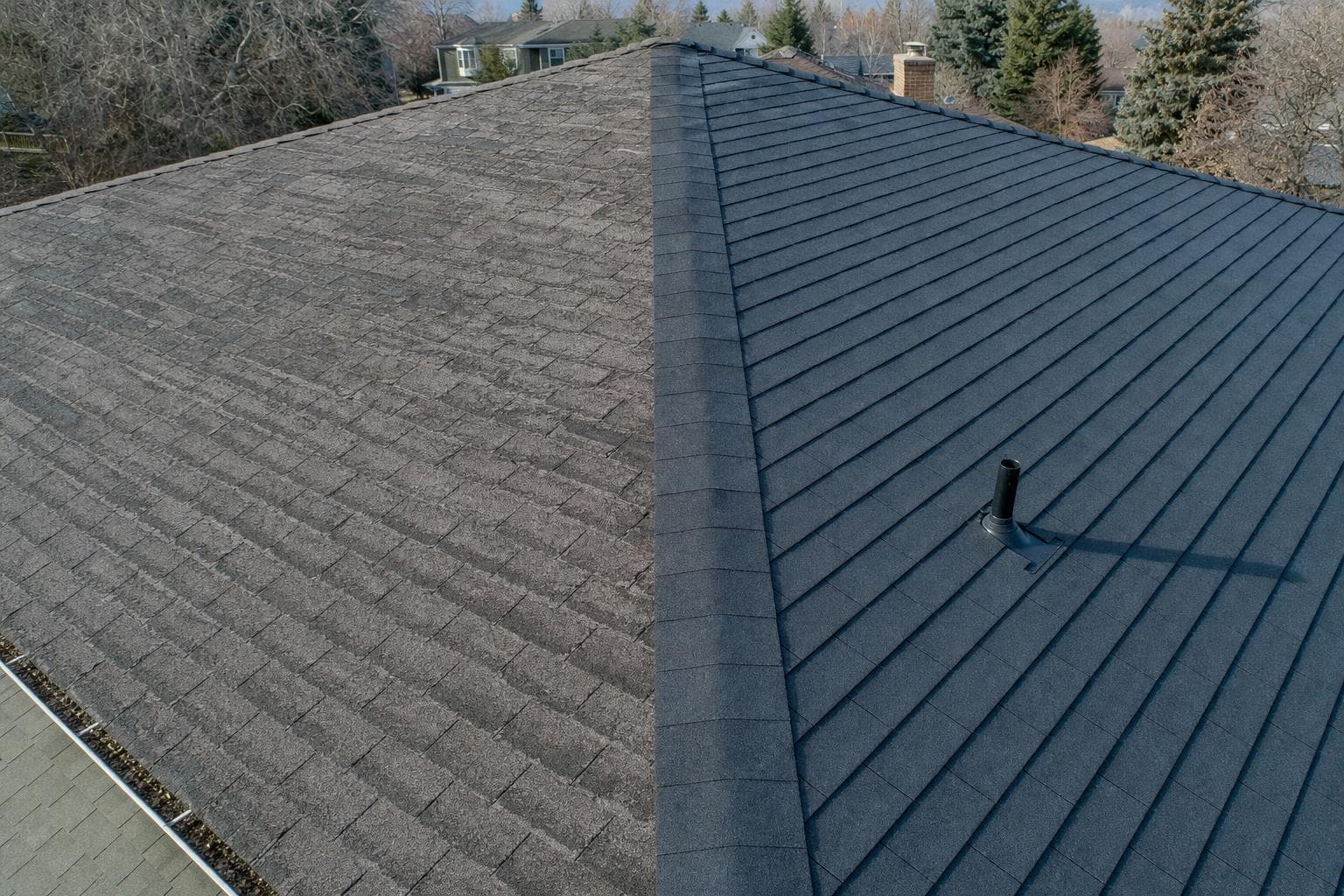
Start with the pattern. Isolated damage stays confined to a small area and has a clear cause, such as a branch strike, one leaking pipe boot, a short run of wind-lifted shingles, or flashing failure around one penetration. Widespread damage shows up in multiple places and usually follows a storm or years of wear. That can include hail bruising across several slopes, repeated edge lifting, granule loss across broad sections, cracked shingles in many rows, or leaks in more than one room. In Colorado, hail and wind often create damage that looks minor from the ground but spans enough of the roof to make patchwork repairs a weak long-term fix.
- Repair usually fits one leak source, one roof section, or one clearly defined problem.
- Replacement usually fits damage across multiple slopes, repeated leak points, or roof-wide wear.
- If new materials would only blend into a failing field of old materials, replacement is often the safer investment.
What is a fixed damage threshold for roof repair vs. replacement?
For roof repair vs replacement in Colorado, do not use a fixed damage percentage as the decision rule; compare the repairable area, roof condition, material availability, code requirements, and written scopes. The reason is straightforward. Once damage spreads past that point, you are often paying for enough tear-off, patching, and matching work that the repair stops being efficient. You also risk ending up with an uneven roof where the repaired areas are newer but the rest is still close to failure.
Talk to a roofer today
Planning ranges, scope details, and a direct path to request a roofing quote.
Does the age of your roof change the answer?
Yes. An older roof is harder to justify repairing because even a well-done patch cannot reverse roof-wide aging. In Colorado, intense sun, hail exposure, freeze-thaw cycling, and wind can age asphalt faster than homeowners expect. If your roof is relatively newer and the damage is clearly limited, a repair can be the smart move. If your roof is already showing broad wear, brittle shingle tabs, repeated repairs, or storm damage on top of age, replacement usually gives you a better result and lowers the chance of another repair bill soon after this one.
How does Colorado weather change the repair vs. replacement decision?
Colorado weather pushes many borderline cases toward replacement. Hail is the biggest reason. A roof may show a few obvious hits, but the real issue can be bruising and granule loss spread across many shingles. Wind is another factor, especially near the foothills and in chinook-prone areas, where edges, ridges, and underlayment can be stressed repeatedly. Add high UV exposure, snow load, and freeze-thaw movement, and a roof that might be repairable in a milder climate may not hold up as well here. If your area gets meaningful hail exposure, Class 4 shingles are worth comparing when replacement is on the table. Ask your carrier in writing whether the product qualifies, which premium portion is affected, and what documentation it requires. For roof repair vs replacement in Colorado, any insurance credit depends on the carrier, policy, address, and exact product; get the amount and documentation requirements from the insurer in writing.
How much does roof repair vs. replacement cost in Colorado?
For current Colorado repair planning related to roof repair vs replacement, use the maintained cost guide, then compare the contractor's measured scope and unit prices. For 2026 Colorado market pricing, Class 3 asphalt runs $6.50/sq ft, or $13,232 on a typical 2,000 sq ft roof. Class 4 runs $7.75, or $15,436. Standing seam metal runs $17.25, or $34,252. For roof repair vs replacement in Colorado, treat a steep or difficult-to-access roof as a scope variable that the contractor should measure and price explicitly. If your repair bill is climbing because damage covers a large share of the roof, comparing that spend against a full replacement often clarifies the smarter move. For a deeper breakdown, full local pricing lives on the Colorado cost page and the calculator.
How long does a roof replacement take in Colorado?
For roof repair vs replacement in Colorado, ask the contractor to put the expected working days and weather plan in writing; timing depends on roof size, material, access, crew scheduling, and conditions found after tear-off. That makes replacement less disruptive than many homeowners expect, especially when the alternative is a series of repairs over time. The schedule can still vary with weather, roof complexity, and steepness, but in many cases the bigger issue is not time on site. It is whether you want to keep investing in an aging roof that Colorado weather will keep testing.
What insurance and contract rules should Colorado homeowners know?
You should know your cancellation rights, your deductible obligation, and what must be in the contract before you sign. Colorado's residential roofing law gives you two ways out of a roofing contract. You can rescind any residential roofing contract within 72 hours of signing it, and if the work is to be paid from insurance proceeds, you can also rescind within 72 hours after your insurer notifies you in writing that the claim is denied in whole or in part. Under the same law, a Colorado roofing contractor cannot pay, waive, rebate, or even promise to pay, waive, or rebate all or part of your insurance deductible on an insurance-funded job. Colorado also does not license roofing contractors at the state level, which puts more weight on the protections written into your contract. Your written contract should spell out scope, cost, approximate start and completion dates, contact and insurance information, and your cancellation and refund rights.
How do you choose the right path for your roof?
If the damage is spread out, the roof is aging, or your local hail and wind exposure have weakened large sections, replacement is usually the better investment. A roofing contractor you are considering can inspect for the damage you cannot see from the ground, show you whether the problem is confined or roof-wide, and help you compare repair cost against 2026 market pricing for a full replacement.
Sources reviewed
- Colorado Attorney General: Preventing Home Repair and Roofing Fraud
- Colorado Division of Insurance / DORA (action to lower homeowners rates; resilient roofs)
- Insurance Institute for Business & Home Safety: RICOWI Roof Guide
- Florida Department of Financial Services: Homeowners Insurance Overview
- Insurance Institute for Business & Home Safety: Roof 101
Cost ranges are estimates developed from standardized project scopes and reviewed pricing inputs. Government labor and regional cost data are used where applicable. See our Pricing Methodology for the exact sources, calculations, and review date. Actual prices vary by property, scope, materials or equipment, location, and provider.
Related services
Updated July 27, 2026
3D Roofs Editorial Team
Editorial Standards