Updated July 27, 2026

3D Roofs Editorial Team
Editorial Standards
If the damage is isolated, a repair usually makes sense. If the damage is spread across multiple areas, the roof is older, or wind and water have exposed weak spots across the system, replacement is often the smarter buy. In Florida, that decision gets tougher because roofs live and die by wind and water. Hurricanes and tropical systems drive wind uplift and wind-driven rain that find any weak fastener, seam, or edge, and that risk runs highest near the coast. On top of that, near-constant sun, heat, humidity, and heavy summer rain age shingles and grow algae faster than in most of the country, and salt air along the shore is hard on metal and flashing. The right choice is not just about today's leak. It is about whether the rest of the roof is likely to fail next season.
Should you repair or replace a roof with isolated damage?
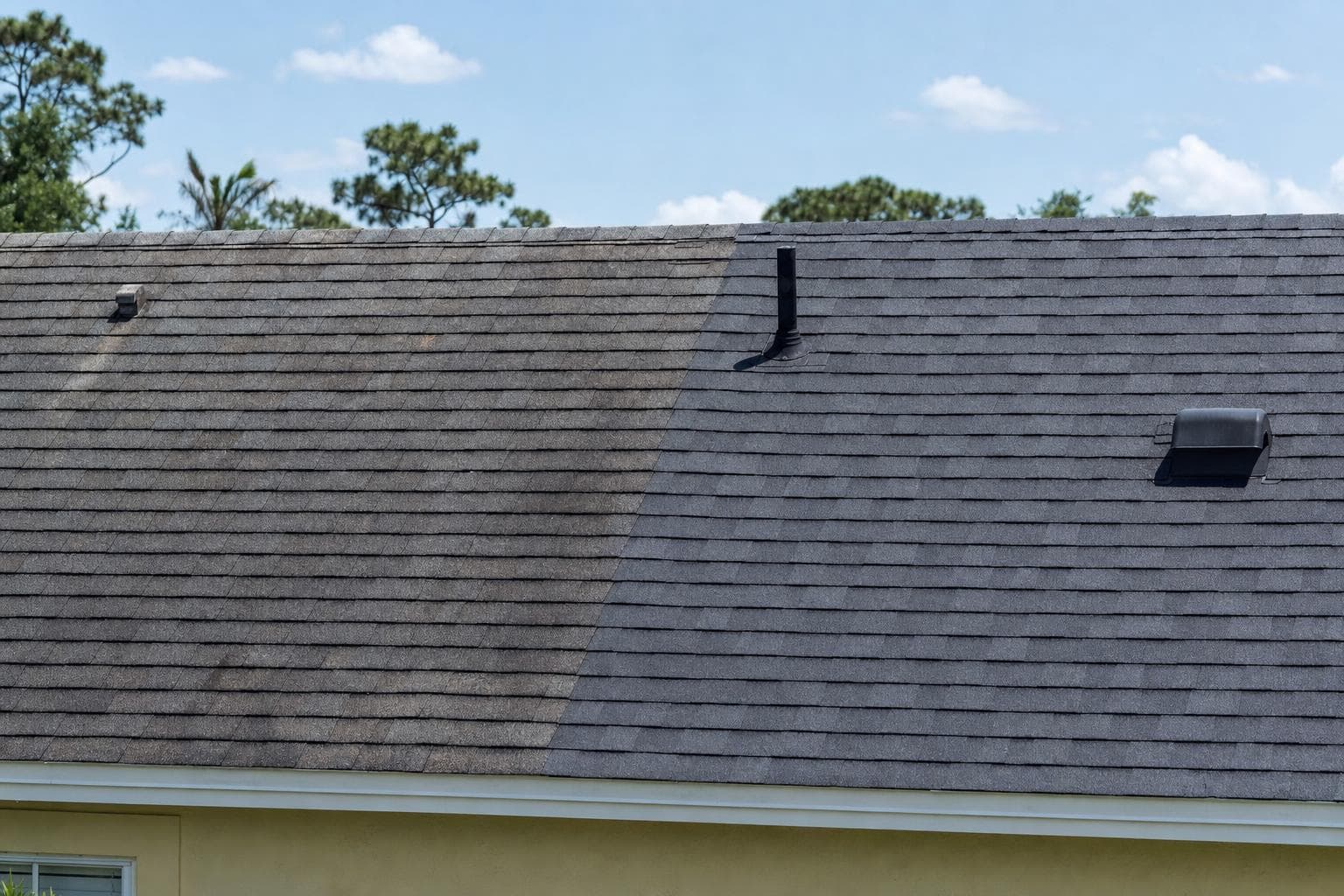
Repair it, if the problem is truly limited to one area and the rest of the roof is still in solid shape. A few missing shingles, a small leak around flashing, a damaged ridge cap, or a localized section lifted by wind can often be fixed without tearing off the whole roof. For current Florida repair planning related to roof repair vs replacement, use the maintained cost guide, then compare the contractor's measured scope and unit prices. That can be the right move when the roof is not near the end of its life and there is no pattern of repeated leaks in other areas.
- Choose repair when damage is confined to one section
- Choose repair when shingles or panels around the damage still hold well
- Choose repair when the roof has years of useful life left
- Choose repair when the issue is tied to one flashing point, vent, valley, or edge detail
When does widespread damage mean replacement is the better call?
Replace the roof when damage shows up in several places, not just one. In Florida, widespread damage often means the roof system has started to lose its grip under heat, rain, and wind exposure. If you have multiple leaks, repeated patch jobs, granule loss across broad shingle areas, lifted edges, loose fasteners, rusting metal details, or storm damage on more than one slope, a repair may only buy you a little time. That is especially true near the coast, where wind exposure and salt air are harder on roofing materials and flashing.
- Multiple leak spots usually point to a system-wide problem
- Repeated repairs often mean the next failure is already forming
- Storm damage across several slopes is a strong sign replacement will make more sense
- If one weak area was caused by age, nearby areas may not be far behind
How old is too old for a roof repair in Florida?
If your roof is older and already showing wear, replacement is usually the safer investment. Florida sun, heat, humidity, and heavy summer rain can age roofing faster than in many other states. Even when a repair is possible, older materials may be brittle, faded, loosened, or hard to match. That matters because a patch only works if the surrounding roof can still do its job. If your roofer fixes one spot but the adjacent sections are worn out, you may end up paying for repairs now and replacement soon after.
A newer roof with one storm-related issue is a different story. In that case, repair often makes sense. The key question is simple: are you fixing a one-off problem, or are you trying to stretch a roof that is already wearing out across the whole system?
Talk to a roofer today
Planning ranges, scope details, and a direct path to request a roofing quote.
What is a fixed damage threshold for roof repair vs. replacement?
For roof repair vs replacement in Florida, do not use a fixed damage percentage as the decision rule; compare the repairable area, roof condition, material availability, code requirements, and written scopes. That is not a Florida law. It is a homeowner rule of thumb that helps separate a focused repair from a roof-wide problem. Once damage reaches a large share of the roof, patching can turn into repeated labor on aging materials, with uneven results and more leak risk at transitions between old and new sections.
Florida law adds another layer. You no longer always have to replace the whole roof to fix part of it. Until 2022, Florida's "25% rule" generally forced a full roof replacement if more than 25% of the roof was repaired or replaced in a year. SB 4-D changed that: if your roof was built to the 2007 Florida Building Code or later, roughly, permitted on or after March 1, 2009, now only the repaired section has to be brought up to current code, not the entire roof. That can be the difference between a repair and a tear-off, so it is worth knowing where your roof stands.
How does Florida weather change the repair vs. replacement decision?
It pushes many borderline cases toward replacement. In a milder climate, you might get away with another patch. In Florida, wind-driven rain can travel under loosened shingles, around flashing, and into weak seams. Hurricanes and tropical systems test every edge and fastener. Heavy summer rain then keeps pressure on anything that is already compromised. That means a roof with scattered weaknesses can fail in several places during one storm cycle, even if it looked manageable before.
This is why exposure matters so much. A home near the coast, in an open neighborhood, or in a county with tougher wind requirements may need a more durable answer than a similar roof farther inland with less exposure. If your roof has already shown signs of uplift, water entry, or edge failure, replacing it with a system designed for your local wind zone can be the smarter move.
How much does roof replacement cost in Florida?
For 2026 market pricing in Florida, Class 3 shingles run $6.25/sq ft, or $12,429 on a typical 2,000 sq ft roof. Class 4 shingles run $7.25, or $14,568. Standing seam metal runs $16.00, or $32,074. For roof repair vs replacement in Florida, treat a steep or difficult-to-access roof as a scope variable that the contractor should measure and price explicitly. For roof repair vs replacement in Florida, ask the contractor to put the expected working days and weather plan in writing; timing depends on roof size, material, access, crew scheduling, and conditions found after tear-off. If you want a deeper breakdown for your area and roof size, full local pricing lives on the Florida cost page and the calculator.
Can a new roof help with Florida insurance costs?
Yes, if the replacement improves verified wind-resistant features. Florida law, Statute 627.0629, requires home insurers to give premium credits for verified wind-resistant features, things like a hip roof shape, a sealed roof deck, and code-rated shingle attachment. A licensed inspector documents them on the state's Uniform Mitigation Verification form, OIR-B1-1802, and the windstorm savings can be substantial. If you are replacing or upgrading a roof, get the wind-mitigation inspection afterward so you actually capture the credit you are owed.
Material choice can matter too. For roof repair vs replacement in Florida, any insurance credit depends on the carrier, policy, address, and exact product; get the amount and documentation requirements from the insurer in writing. Wind-rated and impact-resistant materials matter more in Florida than almost anywhere. Ask which roofing systems carry the right Florida Product Approval or Miami-Dade Notice of Acceptance for your county, and ask how the install will score on the wind-mitigation form before you sign.
What should you ask before choosing repair or replacement in Florida?
Ask whether the problem is isolated or roof-wide, whether your roof was built to the 2007 Florida Building Code or later, and whether your county has stricter product and fastening rules. Florida builds to the Florida Building Code, and Miami-Dade and Broward counties sit in the High-Velocity Hurricane Zone, which carries the toughest wind-resistance roofing rules in the United States. In the HVHZ, every shingle, tile, underlayment, and fastener has to carry a Miami-Dade Notice of Acceptance or Florida Product Approval rated for that zone, and installs follow stricter fastening and underlayment standards. Whoever roofs your home has to pull a permit and meet the code for your area, so confirm they do.
If you are stuck between patching and replacing, the plain answer is this: repair a healthy roof with a limited problem. Replace a worn roof with spread-out damage, repeated leaks, or storm exposure that has already found more than one weak point. In Florida, waiting too long can turn a manageable fix into a bigger water problem. If you want to compare materials and 2026 market pricing before you decide, start with the Florida cost page and the calculator, then talk through your roof's condition with a roofing contractor you are considering.
Sources reviewed
- Citizens Property Insurance Corporation (state insurer of last resort)
- Florida Building Commission / Florida Building Code (HVHZ)
- Insurance Institute for Business & Home Safety: RICOWI Roof Guide
- Florida Department of Financial Services: Homeowners Insurance Overview
- Insurance Institute for Business & Home Safety: Roof 101
Cost ranges are estimates developed from standardized project scopes and reviewed pricing inputs. Government labor and regional cost data are used where applicable. See our Pricing Methodology for the exact sources, calculations, and review date. Actual prices vary by property, scope, materials or equipment, location, and provider.
Related services
Updated July 27, 2026
3D Roofs Editorial Team
Editorial Standards