Updated July 27, 2026

3D Roofs Editorial Team
Editorial Standards
If your roof damage is isolated, a repair usually makes sense. If the damage is spread across multiple areas, the roof is older, or the next storm is likely to exploit the same weak points, replacement is often the smarter long-term move. In Maine, that call matters because snow load, wind-driven rain, freeze-thaw cycles, and storm debris can turn a small roofing problem into an interior leak fast. Coastal exposure, salt air, wooded lots, and falling limbs can push the decision further toward replacement when the roof already has several trouble spots.
Should you repair or replace a roof in Maine?
Repair it when the problem is limited and the rest of the roof is still doing its job. Replace it when the roof has widespread wear, repeated leaks, or enough damaged area that a repair only buys you a little time. For roof repair vs replacement in Maine, do not use a fixed damage percentage as the decision rule; compare the repairable area, roof condition, material availability, code requirements, and written scopes. That is not a law, but it is a practical way to avoid putting money into a roof that is already near the point where more failures are likely.
- Choose repair for a small area of missing shingles, a localized flashing issue, or one leak tied to one clear problem.
- Choose replacement when damage shows up on several slopes, around multiple penetrations, or in repeated leak areas.
- Lean toward replacement if your roof already has patchwork from prior repairs and new issues keep appearing.
- In Maine, lean more cautiously on repairs if freeze-thaw conditions and winter moisture are likely to reopen the same vulnerable areas.
How do you know if the damage is isolated or widespread?
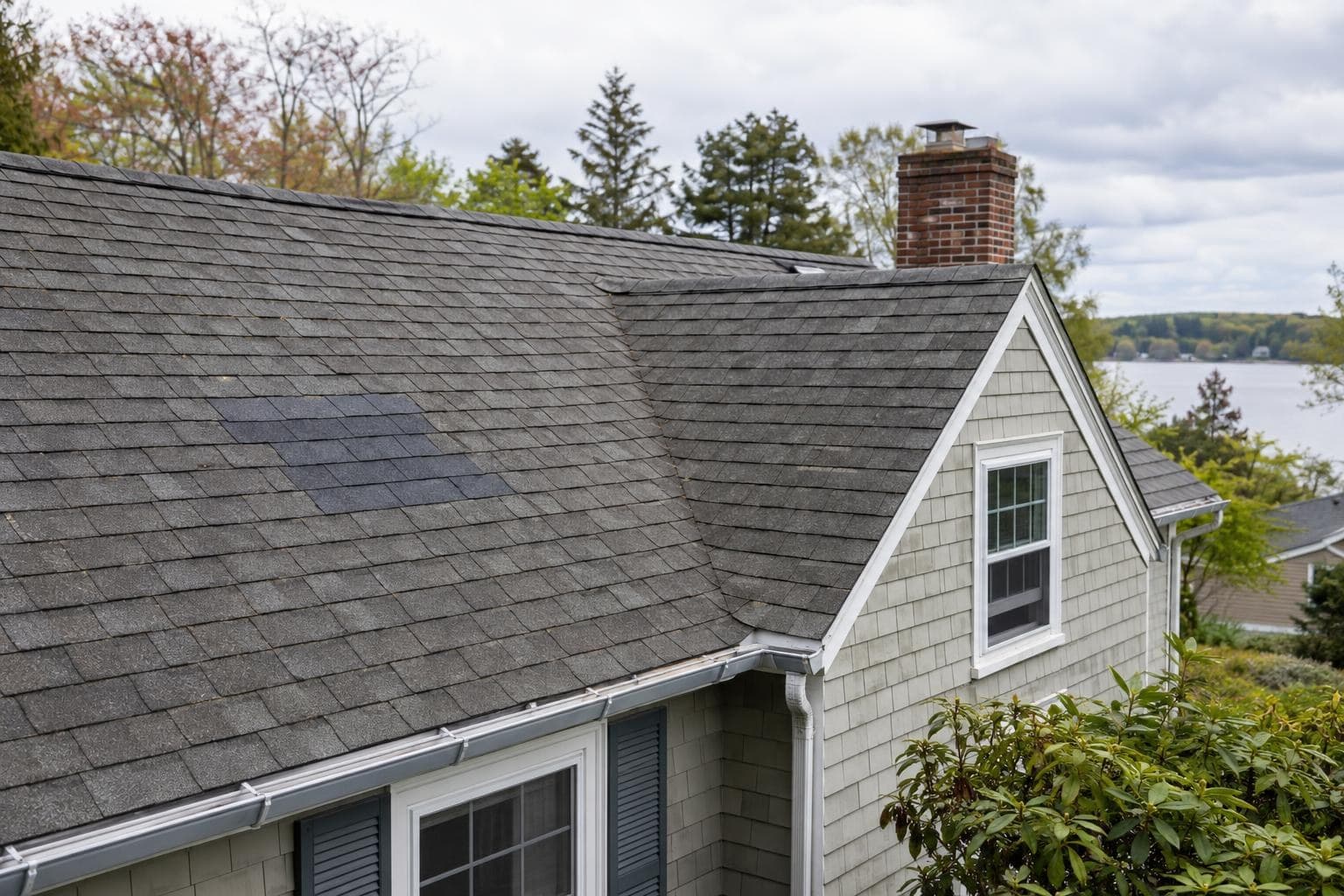
Look for pattern, not just one visible problem. Isolated damage stays in one section and has one likely cause, such as a lifted flashing detail or a limb strike over one plane. Widespread damage shows up in more than one area, often with cracked, loose, or missing shingles, exposed nail heads, granule loss, soft decking, or multiple water-entry points. In Maine, roofs deal with conditions that can loosen shingles and open pathways for water at flashing and roof penetrations, so one stain inside does not always mean one simple exterior fix.
- Isolated damage often means one repair can solve the issue without chasing new leaks later.
- Widespread damage often means the roof system is failing in more than one place, even if only one leak is visible inside today.
- Check valleys, pipe boots, chimney flashing, skylights, and roof-to-wall transitions, because those are common water-entry areas.
- On wooded properties, inspect for branch impact and abrasion. On coastal homes, consider extra wear from wind exposure and salt air.
Does roof age change the repair versus replacement decision?
Yes. The older the roof, the less value you usually get from a repair. If the damaged area can be fixed but the surrounding shingles are brittle, worn, or nearing the end of their useful life, you may pay for a repair now and still face replacement soon. Age matters even more in Maine because winter moisture, ice issues, and repeated freeze-thaw cycles can expose the next weak spot after you fix the first one. If your roof has one clear problem but also shows broad aging, replacement can be the more economical choice over the next few seasons.
Talk to a roofer today
Planning ranges, scope details, and a direct path to request a roofing quote.
What is a fixed damage threshold for roof replacement?
It helps you avoid spending on a major patch that still leaves most of an aging roof in place. The reason is simple. Once damage reaches that level, the roof often has enough compromised areas that matching materials, tying repairs together cleanly, and preventing future leaks gets harder and less cost-effective. In Maine, harsh weather can make that tradeoff even clearer because a roof with many weak areas is more likely to fail again under snow, wind-driven rain, and freeze-thaw movement.
How does Maine weather change the call?
Maine weather makes borderline roofs less forgiving. Snow load, wind-driven rain, freeze-thaw cycles, and storm debris can turn minor defects into active leaks. Water can work into small openings around flashing and penetrations, then expand the problem as temperatures swing. In coastal areas, wind exposure and salt air can add more wear. In wooded parts of the state, falling limbs and tree impact are also part of the risk picture. If you are replacing a roof here, it makes sense to focus on durable materials, clean flashing details, and attic ventilation that helps manage moisture and winter ice issues.
How much does repair cost versus replacement in Maine?
For current Maine repair planning related to roof repair vs replacement, use the maintained cost guide, then compare the contractor's measured scope and unit prices. Replacement is a bigger spend, but it can stop the cycle of repeated fixes when the roof has widespread problems. Based on 2026 market pricing in Maine, Class 3 shingles cost $6.50/sq ft, or $12,862 on a typical 2,000 sq ft roof. Class 4 costs $7.50, or $15,019. Standing seam metal costs $16.75, or $33,271. For roof repair vs replacement in Maine, treat a steep or difficult-to-access roof as a scope variable that the contractor should measure and price explicitly. For roof repair vs replacement in Maine, ask the contractor to put the expected working days and weather plan in writing; timing depends on roof size, material, access, crew scheduling, and conditions found after tear-off.
Is a stronger shingle worth it in Maine?
It often is, especially if your current decision is close and you want better durability on the next roof. Class 4 can make sense if you want more impact resistance against storm debris and tree-related risk. For roof repair vs replacement in Maine, any insurance credit depends on the carrier, policy, address, and exact product; get the amount and documentation requirements from the insurer in writing. If you are considering a Class 4 impact-resistant shingle, ask your carrier whether it offers a homeowners discount for that product and what documentation it requires. Discounts are set by each carrier and policy, so you should not assume a standard savings amount. A roofing contractor you are considering can help you gather product information for your insurer, but your carrier decides eligibility and any discount.
What if storm damage is involved and you plan to file a claim?
Start by protecting the home and documenting everything. Maine says homeowners and property insurance generally cover storm damage, including wind. For roof losses, homeowners policies generally will cover wind damage to the roof. Coverage for interior water damage can depend on the policy type. For roof repair vs replacement in Maine, coverage depends on the policy language, cause of loss, exclusions, and the insurer's decision; verify those terms in your own documents. If possible, take photos or videos before making repairs, keep receipts, and wait on permanent repairs until the insurance adjuster has had a chance to inspect the damage, or the claim may be denied.
- Use temporary measures such as covering holes in the roof if needed to limit further damage.
- Keep receipts for materials and labor used for temporary repairs.
- Save photos, videos, estimates, invoices, and claim documents in one file.
- Ask your roofer for line-item detail that matches what your insurer will need.
What should you ask for before signing a roofing contract in Maine?
Get the scope, price, and change process in writing. Maine says a written contract is required for any home construction or repair work that costs more than an amount that must be confirmed for the written scope. The contract must include certain provisions, including the total contract price, estimated dates when the work will begin and end, a description of the work and materials, and an express warranty of good workmanship. The contractor cannot require more than 1/3 of the contract price as a down payment unless you both agree to exempt yourselves from that requirement. Any change in work or materials that changes the contract price must be stated in a written change order signed by both parties.
In Maine, weather tends to punish weak roofs, so a short-term fix is only worth it when the rest of the system is still sound. If you want to compare materials and budget ranges before you decide, check the Maine cost page and the calculator for full local pricing.
Maine roofing costs
Sources reviewed
Cost ranges are estimates developed from standardized project scopes and reviewed pricing inputs. Government labor and regional cost data are used where applicable. See our Pricing Methodology for the exact sources, calculations, and review date. Actual prices vary by property, scope, materials or equipment, location, and provider.
Related services
Updated July 27, 2026
3D Roofs Editorial Team
Editorial Standards