Updated July 27, 2026

3D Roofs Editorial Team
Editorial Standards
A shingle roof in Michigan lasts less when winter moisture, freeze-thaw cycling, ice dams, summer wind, and hail keep working on it year after year. The big question is not just how old the roof is. It is how well it has handled heavy snow, lake-effect weather, attic heat loss, flashing movement, and storm hits. If your roof has made it through several Michigan winters, the best next step is to look at condition, not just the calendar.
How long does a shingle roof last in Michigan?
It depends on weather exposure, attic conditions, installation quality, and storm history. Michigan roofs fail where winter hits hardest. Heavy snow, and lake-effect bands off Lakes Michigan, Superior, and Huron, pile snow load onto the structure, while the constant freeze-thaw cycling expands and contracts everything and pries at flashing and fasteners. The biggest cold-weather threat is ice dams: heat escaping into the attic melts snow that refreezes at the cold eaves, and the backed-up water forces its way under the shingles. Summer is not a break either. Thunderstorms across the Lower Peninsula bring straight-line winds and hail, especially in the southern and southeastern counties, that bruise shingles and strip granules. In plain terms, a Michigan shingle roof can age faster than a roof in a milder climate, especially if small problems keep getting ignored.
What makes a shingle roof wear out faster in Michigan?
The main causes are trapped heat in the attic, bad ventilation, ice dams, repeated freeze-thaw movement, and storm damage. When warm air leaks into the attic in winter, it melts snow on the roof deck. That water runs down to the colder eaves, freezes, and creates the ice dam that pushes water up under shingles. At the same time, expansion and contraction loosen flashing and fasteners around valleys, chimneys, walls, and roof penetrations. Add strong summer storms, and even a roof that still looks decent from the yard can have bruised shingles, lost granules, lifted tabs, or small leak paths that spread over time.
- Ice dams that force water beneath shingles at the eaves
- Freeze-thaw cycling that pries at flashing and fasteners
- Heavy snow load, especially in lake-effect areas
- Straight-line winds that lift or crease shingle tabs
- Hail that bruises shingles and strips granules
- Poor attic air sealing, insulation, or ventilation
- Weak details at valleys, penetrations, and flashing transitions
How can you tell if your shingle roof is aging out?
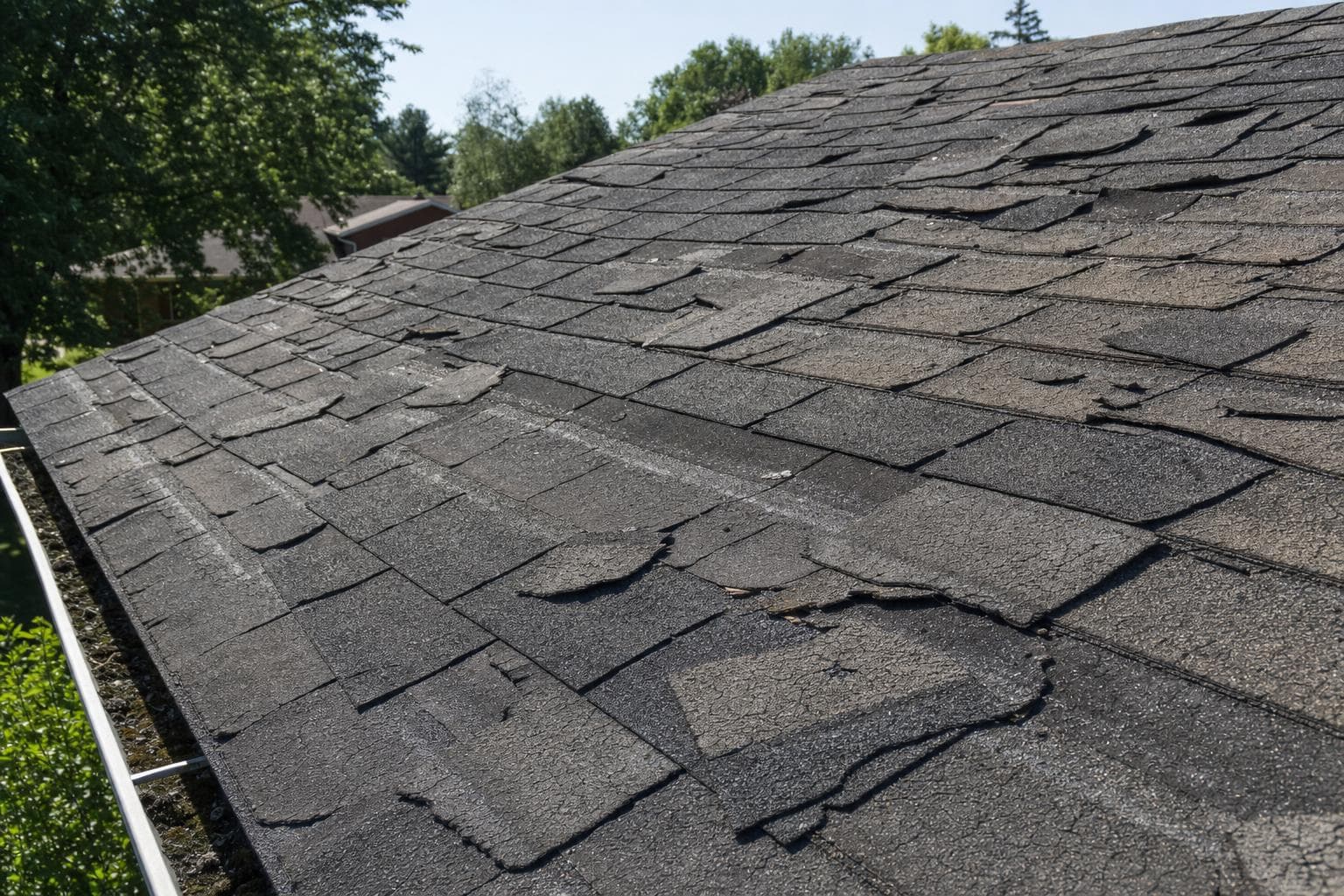
The clearest signs are repeated leaks, missing or damaged shingles, granule loss, flashing trouble, and interior moisture after storms or thaw cycles. An aging roof usually shows a pattern, not just one isolated issue. You may notice shingles that look thin or worn, dark streaks where water hangs around, tabs that no longer lie flat, or metal details that have started to separate. Inside the house, the clues are often staining near exterior walls, damp attic decking, or signs of water after an ice dam event. If repairs keep popping up in different areas, the roof may be nearing the point where patching no longer makes financial sense.
Talk to a roofer today
Planning ranges, scope details, and a direct path to request a roofing quote.
What warning signs should you look for after a Michigan winter?
Look for damage at the eaves, in valleys, around flashing, and anywhere snow and ice sit longest. Michigan winters tend to expose weak spots fast. After the snow clears, check the ground for shingle pieces or heavy granule loss. From a safe view, look for bent gutters, lifted shingles, uneven roof lines, or areas that stay damp longer than the rest. In the attic, look for wet insulation, staining, moldy smells, or rusty fasteners. These are common signs that melting and refreezing water found a way in. A roof does not have to be actively leaking into a room to be in trouble.
Does wind and hail damage shorten roof life even if the roof is not leaking yet?
Yes. Wind and hail can shorten roof life before a visible leak starts. Straight-line winds can break the seal on shingles, lift edges, or crease tabs. Hail can bruise the mat and knock off granules, which leaves the shingle more exposed to sun and weather afterward. Once that protective surface is reduced, wear tends to speed up. This matters in Michigan because summer thunderstorms across the Lower Peninsula can hit a roof that already took a beating through winter. If your roof has gone through multiple wind or hail events, an inspection can tell you whether repair is enough or whether the damage is widespread.
Can repairs extend the life of a shingle roof in Michigan?
Yes, if the issues are limited and caught early. For current Michigan planning prices related to shingle roof lifespan, use the cost guide and calculator, then compare the contractor's property-specific written scope. The key is whether the rest of the roof still has serviceable shingles and sound roof decking. If damage is spread across many slopes, if leaks keep returning, or if the roof has broad granule loss and storm wear, repairs may only delay replacement for a short time. A roofing contractor you are considering can tell you if you are fixing a problem or just chasing one.
When does replacement make more sense than another repair?
Replacement makes more sense when the roof has widespread wear, repeated leak history, or storm damage across multiple sections. It also makes sense when the underlying problem is bigger than a surface patch, such as chronic ice damming tied to attic conditions and weak water protection details. In Michigan, water protection and attic conditions matter as much as the shingle classification. Ask how the proposal handles eaves, valleys, penetrations, air sealing, insulation, and balanced ventilation. For shingle roof lifespan in Michigan, ask the contractor to put the expected working days and weather plan in writing; timing depends on roof size, material, access, crew scheduling, and conditions found after tear-off.
What should you compare if you are replacing a shingle roof in Michigan?
Compare the full water-management system, attic details, and material class, not just the shingle color or base price. For shingle roof lifespan in Michigan, treat a steep or difficult-to-access roof as a scope variable that the contractor should measure and price explicitly. If hail exposure is part of your concern, Class 4 shingles are worth comparing, but verify the exact product and insurer treatment. For shingle roof lifespan in Michigan, any insurance credit depends on the carrier, policy, address, and exact product; get the amount and documentation requirements from the insurer in writing. Any credit is carrier- and policy-specific, so obtain eligibility and documentation requirements in writing before using it in the budget. For broader replacement budgeting, full local pricing lives on the Michigan cost page and the calculator.
What should you know about insurance and hiring a roofer in Michigan?
First, know your deductible and policy settlement type before you file a storm claim. For shingle roof lifespan in Michigan, review the declarations and endorsements for any wind, hail, hurricane, or named-storm deductible. Ask the insurer to show the policy-specific calculation in writing instead of relying on a generic percentage. On a an amount that must be confirmed for the written scope home that can be an amount that must be confirmed for the written scope to an amount that must be confirmed for the written scope out of pocket before the insurer pays anything. Coverage also depends on whether your roof is insured at replacement cost or actual cash value: on an older roof, an ACV policy pays only the depreciated value, and some policies exclude purely cosmetic hail dents. Read your declarations page so the payout does not surprise you.
Second, verify the roofer is legally allowed to do residential roofing work in Michigan. Michigan licenses residential roofing at the state level. Under Article 24 of Public Act 299 of 1980, a contractor doing roofing on homes must hold either a Residential Builder license or a Maintenance and Alteration (M&A) Contractor license carrying the roofing classification (trade code "M"), issued by the Bureau of Construction Codes under the Department of Licensing and Regulatory Affairs (LARA). Ask for the contractor's Residential Builder or Maintenance and Alteration (M&A) Contractor license with the roofing classification, and confirm it is active through LARA's license lookup. For shingle roof lifespan in Michigan, do not assume a contractor can remove or hide the deductible required by the policy. Verify current state law and the written proposal with the insurer or state insurance regulator before signing.
Sources reviewed
- Michigan Attorney General - Building and Remodeling: Advice for Homeowners
- Michigan DIFS - Tornado / Severe Storms consumer guidance
- UL Solutions: UL Solutions and IBHS Drive Trust in Residential Roofing Shingles
- Asphalt Roofing Manufacturers Association: Residential Asphalt Roofing Manual: Ventilation Best Practices
- Insurance Institute for Business & Home Safety: Natural Weathering and Hazard Exposure
Plan with current pricing
Related services
Updated July 27, 2026
3D Roofs Editorial Team
Editorial Standards