
Updated July 10, 2026

3D Roofs Editorial Team
Editorial Standards
How to specify a complete shingle roof in Michigan
Begin with the exact shingle and its published classifications, warranty, color, and local availability. Then compare the accessories and details required for that product and roof. A quote using a premium shingle can still be incomplete if it reuses failed flashing, ignores intake ventilation, or leaves decking and edge work undefined.
Ask the roofer to identify every system component, fastening method, deck requirement, ventilation calculation, flashing treatment, and warranty registration step. Keep manufacturer coverage separate from the contractor's workmanship obligation and ask who handles each type of problem.
How Michigan exposure changes a shingle system
Michigan roofs fail where winter hits hardest. Heavy snow, and lake-effect bands off Lakes Michigan, Superior, and Huron, pile snow load onto the structure, while the constant freeze-thaw cycling expands and contracts everything and pries at flashing and fasteners. The biggest cold-weather threat is ice dams: heat escaping into the attic melts snow that refreezes at the cold eaves, and the backed-up water forces its way under the shingles. Summer is not a break either. Thunderstorms across the Lower Peninsula bring straight-line winds and hail, especially in the southern and southeastern counties, that bruise shingles and strip granules.
Shingle selection in Michigan should follow actual wind, hail, heat, freeze-thaw, wildfire, algae, tree, and moisture exposure. Impact or wind classifications describe tested performance under specific methods; they do not guarantee that a roof cannot be damaged in the field.
What a complete shingle-roofing scope should cover
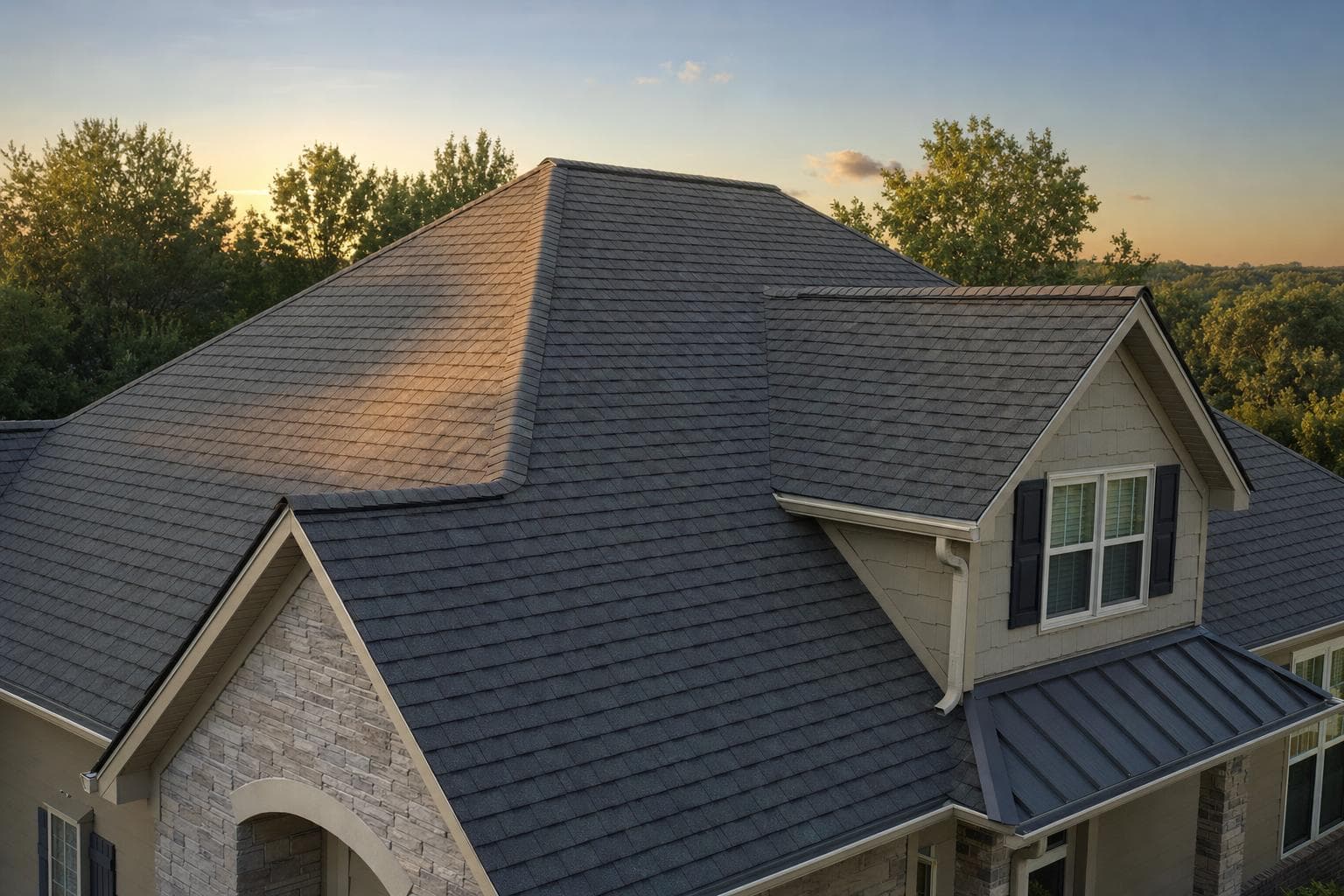
A shingle roof is a layered assembly. The named shingle, starter, ridge, underlayment, leak barriers, flashing, fasteners, ventilation, deck preparation, and installation method work together, so product comparisons make sense only when the supporting scope is the same. Compare the exact shingle system, preparation, water-shedding details, ventilation, deck assumptions, and warranty responsibilities. The checklist below helps identify bids that name the visible shingle but omit the parts that make it a roof.
Products and hidden work to define
- Measured roof, removal layers, deck condition, flashing, ventilation, and repairability review
- Named shingle manufacturer, product line, color, impact and wind classifications, and availability
- Underlayment, specified leak barriers, starter, hip and ridge, drip edge, and fasteners
- Valleys, walls, chimneys, skylights, pipe boots, vents, and other penetrations
- Decking and concealed-work prices, photographs, approvals, and open-roof weather protection
- Property protection, cleanup, permits or inspections, and closeout records
- Separate manufacturer material and contractor workmanship warranty documents
Conditions that change shingle-roof cost
- Measured roof area, waste, pitch, height, access, geometry, and removal layers
- Exact shingle line, classification, color, availability, and accessory system
- Decking, attachment, flashing, valleys, penetrations, and concealed prior work
- Underlayment, leak barriers, edges, starter, ridge, fasteners, and ventilation
- Permit, inspection, product, association, fire, or wind requirements where applicable
- Property protection, weather sequencing, disposal, cleanup, and closeout records
What to resolve before shingles are ordered
Compare the exact product line and tested classifications, not broad labels such as architectural or impact resistant. Then compare the hidden layers, accessory compatibility, warranty requirements, local availability, and price of the complete installed system.
- The quote lists field shingles but not starter, ridge, underlayment, or flashing
- No decking or concealed-work price and approval method exists before tear-off
- The exact shingle line, accessory system, or installation requirements are not named
- A Class 3, Class 4, architectural, or warranty label is treated as the complete specification
- The warranty pitch ignores the difference between material and workmanship responsibility
- Which exact shingle line, classification, color, and compatible accessory system are included?
- What deck, underlayment, leak-barrier, edge, starter, ridge, flashing, fastener, and ventilation work is specified?
- How are concealed conditions photographed, priced, authorized, and protected from weather?
- What is the written Class 4 upgrade cost, and does the insurer recognize this exact product?
- Which material and workmanship warranty terms apply, and who handles each obligation?
What shingle roofing costs in Michigan
On a 2,000 sq ft reference roof in Michigan, Class 3 architectural shingles are about $13,576 and Class 4 impact-resistant shingles are about $15,768. Compare exact product lines and the complete supporting assembly before treating the difference as an upgrade price.
- Class 3 architectural shingles
- $6.75 per sq ft on a 2,000 sq ft reference roof
- $13,576
- Class 4 impact-resistant shingles
- $8.00 per sq ft on the same reference roof
- $15,768
Cost ranges are estimates developed from standardized project scopes and reviewed pricing inputs. Government labor and regional cost data are used where applicable. See our Pricing Methodology for the exact sources, calculations, and review date. Actual prices vary by property, scope, materials or equipment, location, and provider.
Rules, claims, and contractor checks
Check local permit and product requirements, homeowner-association restrictions, and any Michigan insurance documentation needed for a product credit. Do not assume a Class 4 label creates an automatic discount; verify the exact shingle with the carrier before ordering.
Residential roofing requires a state license, so verify it
Michigan licenses residential roofing at the state level. Under Article 24 of Public Act 299 of 1980, a contractor doing roofing on homes must hold either a Residential Builder license or a Maintenance and Alteration (M&A) Contractor license carrying the roofing classification (trade code "M"), issued by the Bureau of Construction Codes under the Department of Licensing and Regulatory Affairs (LARA). "Unlicensed roofer" is not just a red flag here, it means they are not legally allowed to do the work for compensation.
Know your wind and hail deductible before you file
Michigan roof coverage depends on the reported cause and the policy's deductible, exclusions, roof provisions, and valuation method. Review the declarations page for any separate wind or hail deductible, cosmetic-damage term, roof schedule, and replacement-cost or actual-cash-value provision. If the deductible is percentage-based, apply the stated percentage to the coverage base identified by the policy rather than the home's market value. Ask the insurer to show that calculation and explain any depreciation in writing before using an expected claim payment in the roofing budget.
Your roofer can't pay your deductible, and DIFS handles disputes
In Michigan it is illegal for a contractor to waive, rebate, or absorb your insurance deductible, and it is treated as insurance fraud, so a "free roof" pitch that eats your deductible is a contract to avoid, not a deal. If a contractor solicited the job at your home, the Home Solicitation Sales Act gives you three days to cancel in writing. If a storm claim is wrongly denied or delayed, you can file a complaint with the Department of Insurance and Financial Services (DIFS) at michigan.gov/difs or 877-999-6442.
Because Michigan actually licenses residential roofing, your first step is to verify it. Ask for the contractor's Residential Builder or Maintenance and Alteration (M&A) Contractor license with the roofing classification, and confirm it is active through LARA's license lookup. From there, vet what you can verify: current general-liability and workers'-compensation insurance, a real local track record and references, manufacturer certifications, and a written scope that spells out tear-off, decking, underlayment, ice-and-water shield at the eaves and valleys, flashing, ventilation, and cleanup. Knowing the deductible and DIFS rules above is the other half of the job.
Sources: Michigan LARA - Maintenance & Alteration Contractor license information · Michigan DIFS - Your Guide to Homeowners Insurance · Michigan DIFS - Tornado / Severe Storms consumer guidance · Michigan Attorney General - Building and Remodeling: Advice for Homeowners
Common questions about shingle roofing in Michigan
How should I compare shingle products in Michigan?+
Compare the exact line, published impact and wind classifications, installation requirements, warranty terms, color and availability, then compare the complete accessory system. A category such as architectural or Class 4 is not enough to define the product or installed roof.
Are Class 4 shingles worth it in Michigan?+
They are worth comparing where impact exposure is meaningful and the installed premium fits your ownership plan. Class 4 is a test classification, not a hail-proof promise. Verify the exact product, local availability, warranty, and any carrier-specific credit before counting savings.
What should a shingle roof quote include?+
It should cover tear-off, deck inspection and pricing, underlayment, leak barriers, drip edge, starter, field shingles, ridge or hip products, flashing, pipe boots, ventilation, fasteners, disposal, cleanup, permits, and separate material and workmanship warranties.
How long do shingles last in Michigan?+
Service depends on the product, climate, slope, orientation, ventilation, attic conditions, installation, storm exposure, tree cover, and maintenance. Inspect by condition and follow the manufacturer's written requirements instead of treating one national age range as a guarantee.
Which Michigan rules should I check before signing a shingle roofing contract?+
Start with the verified state guidance on this page, including Residential roofing requires a state license, so verify it; Know your wind and hail deductible before you file; Your roofer can't pay your deductible, and DIFS handles disputes. Then confirm the permit authority and any local contractor requirement for the property address. Insurance coverage and policy interpretation remain separate from the roofing contract.
What should Michigan homeowners know about impact-resistant roofing?+
In Michigan, water protection and attic conditions matter as much as the shingle classification. Ask how the proposal handles eaves, valleys, penetrations, air sealing, insulation, and balanced ventilation. Class 4 shingles are also worth comparing where hail exposure is a concern, but verify the exact product and insurer treatment. Any credit is carrier- and policy-specific, so obtain eligibility and documentation requirements in writing before using it in the budget.
Shingle Roofing across 31 Michigan cities
Use the nearest Michigan city page for local weather and material context. Final product selection should reflect the home's roof geometry, exposure, appearance requirements, budget, and expected ownership period.
