
Updated July 10, 2026

3D Roofs Editorial Team
Editorial Standards
How to assess wind damage in Kansas before it is repaired
Wind pressure acts differently at corners, eaves, rakes, ridges, roof-to-wall transitions, and changes in height. A useful inspection reviews those areas by roof slope and distinguishes new displacement or creasing from installation issues, age, thermal movement, and previous repairs. The scope should restore attachment and water shedding, not only replace the most visible piece.
Record the event date, photograph ground-visible conditions and interior water evidence, and protect openings when safe. Ask the roofer to identify affected roof areas, surrounding seal and fastener condition, edge and flashing work, matching material, and how the repair will tie into sound roofing.
How Kansas wind and storms change the inspection
Kansas roofs fail where the weather hits hardest, and hail leads the list. Spring and summer storms drive large, repeated hail that bruises shingles, strips granules, and can punch through, and the state takes more big hail than almost anywhere in the country. Tornadoes and straight-line winds add the next layer, peeling shingles and underlayment off edges, ridges, and rakes when a storm comes through. On top of that, hot summers and a heavy UV load age asphalt faster, and winter brings ice and repeated freeze-thaw that pry at flashing, seals, and gutters. The right roof for your home has to stand up to all of it, not just one season.
Wind exposure within Kansas changes with storm type, direction, terrain, building height, roof shape, edge geometry, and local code. The inspection should connect the observed pattern to the actual event and assembly rather than relying only on a reported gust or neighborhood damage.
What a wind-damage repair should document
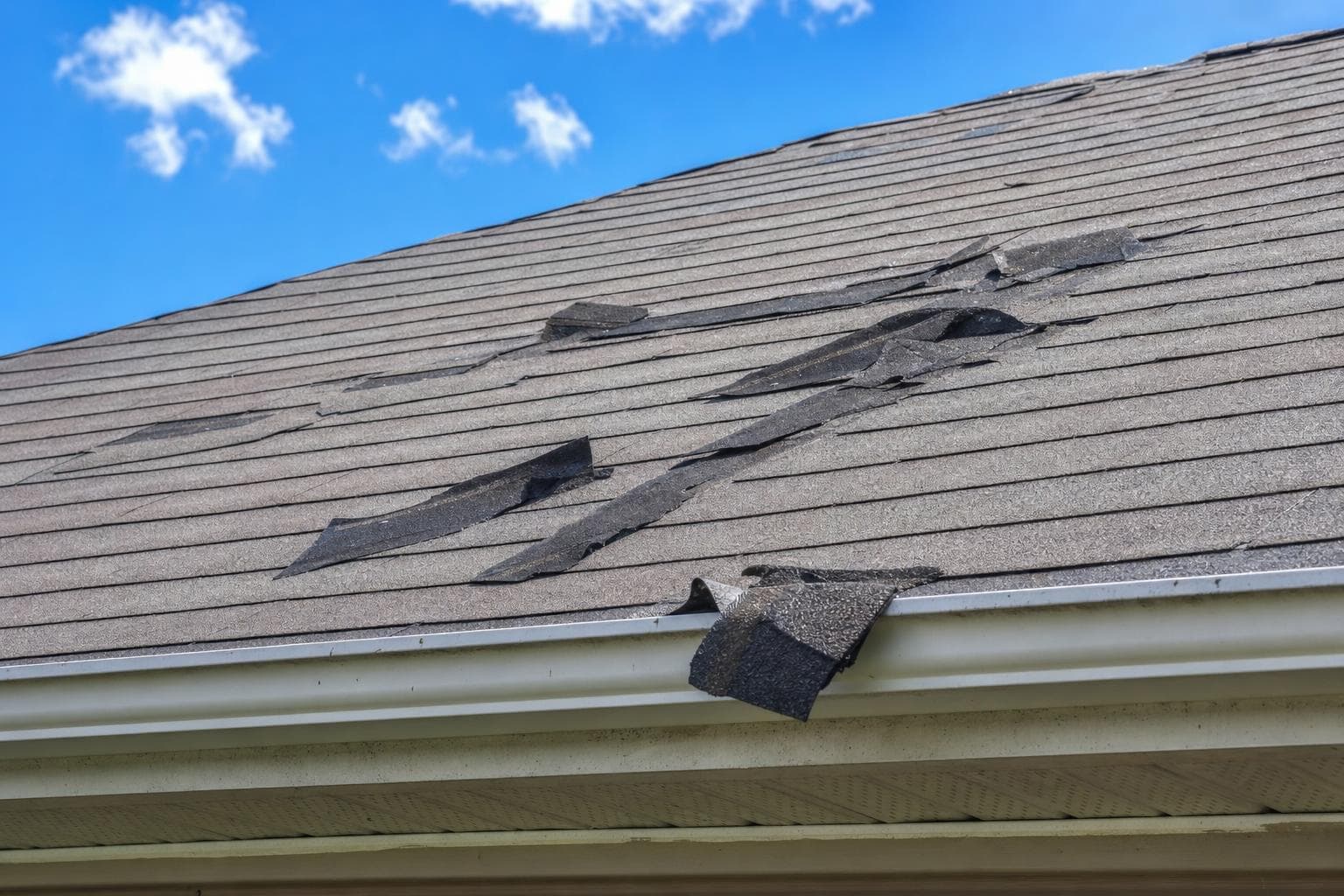
Wind repair should map how uplift moved across the roof. Missing shingles are obvious, but creases, broken seals, lifted ridge, loose edge metal, displaced flashing, and wind-driven rain can extend beyond the area visible from the yard. The repair scope should identify affected roof areas, attachment, edges, ridge, flashing, penetrations, matching material, temporary protection, and completion photographs. A few replacement shingles may not address a failed edge or flashing detail that allowed wind-driven rain inside.
What the repair scope should include
- Inspection by roof area, including slopes, ridge, rakes, eaves, and edges
- Photographs of lifted, creased, missing, or displaced materials before repair
- Flashing, vent, penetration, and interior water-path review
- Named repair areas, matching material, fastening, sealing, and tie-in method
- Temporary protection and completion photographs when those steps are needed
Conditions that change repairability and cost
- Number and distribution of affected roof areas
- Ridge, edge metal, flashing, vent, or penetration work
- Roof pitch, stories, access, debris, and temporary protection
- Matching material and the condition of adjacent seals
- Exposed decking, structural damage, or interior moisture
Questions to resolve before permanent work
Before permanent work, confirm the affected roof areas, damage pattern, tie-in method, matching material, and condition of adjacent seals. The proposal should explain whether one repair restores the roof or whether distributed damage makes repeated spot work unreliable.
- The proposal counts only missing shingles from the ground
- Photographs are not identified by roof area
- The contractor promises an insurance outcome
- The repair does not explain adjacent attachment, edge, or flashing conditions
- Which roof areas show observed wind effects, and what moved in each one?
- Can the surrounding material accept a durable repair without breaking?
- How will the work restore attachment and water shedding?
- Which temporary, concealed, or non-roofing work is priced separately?
What wind-damage repair costs in Kansas
Wind repair commonly starts around $300-$1,500 for a contained area and reaches $1,100-$6,100 when a larger section, ridge, edge metal, or flashing needs restoration. Decking or structural work sits above that range.
- Missing or creased shingles
- A contained area with serviceable matching material around it
- $300-$1,500
- Roof section plus flashing
- A wider repair with displaced transitions or broken seals
- $1,100-$6,100
- Ridge cap or vent damage
- Accessory replacement and tie-in at the roof peak
- $400-$2,400
- Decking or structural damage
- Carpentry plus roofing after wind exposes or moves the substrate
- $2,700-$14,100
Cost ranges are estimates developed from standardized project scopes and reviewed pricing inputs. Government labor and regional cost data are used where applicable. See our Pricing Methodology for the exact sources, calculations, and review date. Actual prices vary by property, scope, materials or equipment, location, and provider.
Rules, claims, and contractor checks
When insurance is involved, preserve pre-repair evidence and review Kansas rules for storm contracts, deductibles, licensing, and claim representation. The roofer should document construction findings while the insurer determines coverage.
Your roofer has to be registered with the Kansas Attorney General
Kansas does not issue a statewide roofing license, but it does require registration. Under the Kansas Roofing Registration Act (K.S.A. 50-6,121 et seq.), in effect since July 1, 2013, any contractor providing roofing services for a fee must hold a roofing contractor registration certificate from the Kansas Attorney General and carry a registration number. That number has to be submitted to pull permits and shown on the company's vehicles, signs, cards, correspondence, and contracts. You can confirm a contractor in the Attorney General's public Roofing Registration Directory before you sign. Registration is not a license or a stamp of quality, though, so it is the floor, not proof the work will be good.
Your roofer can't pay your deductible, and you can cancel if the claim is denied
Under Kansas law, a residential roofing contractor doing insurance-funded work cannot advertise or promise to pay or rebate all or any part of your insurance deductible, and doing so is treated as an unconscionable act under the Kansas Consumer Protection Act. You also get a way out: you can cancel a residential roofing contract within 72 hours of signing, and if the work is to be paid from insurance and your insurer denies the claim in whole or in part, you can cancel on that basis too. When you cancel, the contractor has to return any payments you made, generally within 10 days. So a denied claim does not lock you into paying for a roof out of pocket, and a "free roof, we'll eat your deductible" pitch is a red flag, not a deal.
Hail and wind often carry a separate percentage deductible
Kansas roof coverage depends on the reported cause and the policy's deductible, exclusions, roof provisions, and valuation method. Check the declarations page to see whether wind or hail uses a flat-dollar or percentage deductible and whether the roof is valued at replacement cost or actual cash value. As a math example only, a 2 percent deductible applied to $300,000 of dwelling coverage would equal $6,000; do not assume that percentage or calculation applies to your policy. Also review cosmetic-damage terms and any roof-specific depreciation schedule. Ask the insurer to explain the current terms in writing, and use the Kansas Insurance Department's complaint process if you believe the claim was mishandled.
Because Kansas registers roofers instead of licensing them, your first move is concrete: get the contractor's Kansas roofing registration number and confirm it in the Kansas Attorney General's Roofing Registration Directory. Remember that registration is the floor, not a guarantee of quality, so verify the rest. Many cities and counties also require a local license and a pulled permit, so check what your jurisdiction requires before work begins. Ask for proof of current general-liability and workers'-compensation insurance so you are not on the hook if someone is hurt on your roof, look for a real local track record with references and recent addresses you can drive past, and get a written scope that spells out tear-off, decking, underlayment, flashing, ventilation, and cleanup. Be especially wary of out-of-state storm chasers who appear right after a hailstorm, push you to sign on the spot, and want a large deposit up front. The 72-hour cancellation and deductible rules exist precisely to stop those tactics.
Sources: Kansas Attorney General (Roofing Registration; Kansas Roofing Registration Act) · Kansas Attorney General (Roofing Registration Directory; verify a contractor) · Kansas Attorney General (Roofing Information for Consumers; deductible and cancellation FAQ) · Kansas Insurance Department (homeowners insurance; storms and consumer complaints)
Common questions about wind damage roof repair in Kansas
Can wind damage a roof without removing shingles?+
Yes. Wind can lift edges, break adhesive seals, crease shingles, loosen ridge or flashing, and drive rain through vulnerable transitions without leaving a large bare area. A close inspection should document those conditions and distinguish them from age or installation problems.
Can wind-damaged shingles be resealed?+
Sometimes a contained repair is possible, but the answer depends on creasing, tears, fastener damage, product condition, surrounding seals, and manufacturer instructions. A visibly flattened shingle is not necessarily restored if its mat or attachment was compromised.
What should a wind repair estimate include?+
It should identify affected roof areas, removal, replacement material, fastening and seal requirements, edge and ridge details, flashing, matching limitations, deck findings, cleanup, photographs, and workmanship coverage. Ask how the repair restores both attachment and water shedding.
Will insurance cover wind repair in Kansas?+
Coverage depends on the policy, cause of loss, deductible, exclusions, roof provisions, and insurer's investigation. Document the condition promptly and let the insurer decide coverage; the contractor's role is to explain the observed roof and proposed construction scope.
Which Kansas rules should I check before signing a wind damage contract?+
Start with the verified state guidance on this page, including Your roofer has to be registered with the Kansas Attorney General; Your roofer can't pay your deductible, and you can cancel if the claim is denied; Hail and wind often carry a separate percentage deductible. Then confirm the permit authority and any local contractor requirement for the property address. Insurance coverage and policy interpretation remain separate from the roofing contract.
Wind Damage across 7 Kansas cities
Use the nearest Kansas city page for local wind and storm context. The final repair should be based on your roof's geometry, exposure, attachment, and documented damage pattern.
