Updated July 27, 2026

3D Roofs Editorial Team
Editorial Standards
ACV pays for your roof minus depreciation. RCV pays the cost to replace it, then subtracts your deductible, with depreciation often paid back later once the work is complete. If you own a home in North Carolina, that difference can decide whether your claim feels manageable or turns into a major out-of-pocket bill.
What is the difference between ACV and RCV roof coverage?
ACV means actual cash value. In plain terms, your insurer looks at what your older roof was worth at the time of loss, not what a new roof costs today. RCV means replacement cost value. That means the claim is based on what it costs to replace the damaged roof with like kind and quality, subject to your policy terms and deductible. For most homeowners, RCV is the coverage that better matches the real cost of getting a new roof installed after a covered loss.
Why does ACV vs RCV matter so much in North Carolina?
It matters because North Carolina roof damage is not one-size-fits-all. North Carolina roofs fail where the weather hits hardest, and that varies across the state. On the coast and the Outer Banks, hurricanes and tropical storms drive wind uplift and wind-driven rain that find any weak seam or loose flashing. Inland, across the Piedmont and the foothills, spring and summer thunderstorms bring hail and damaging winds that bruise shingles and break their factory seals. The warm, humid climate also feeds dark algae streaking and can rot decking and trap moisture where ventilation is poor, and the Piedmont and mountains see occasional ice and freeze-thaw swings in winter. The right roof for your home depends on which of these your area actually sees. When a loss happens, the gap between a depreciated payout and a full replacement-cost payout can be the difference between patching what you can afford and replacing what your home actually needs.
How does a simple ACV vs RCV roof claim example work?
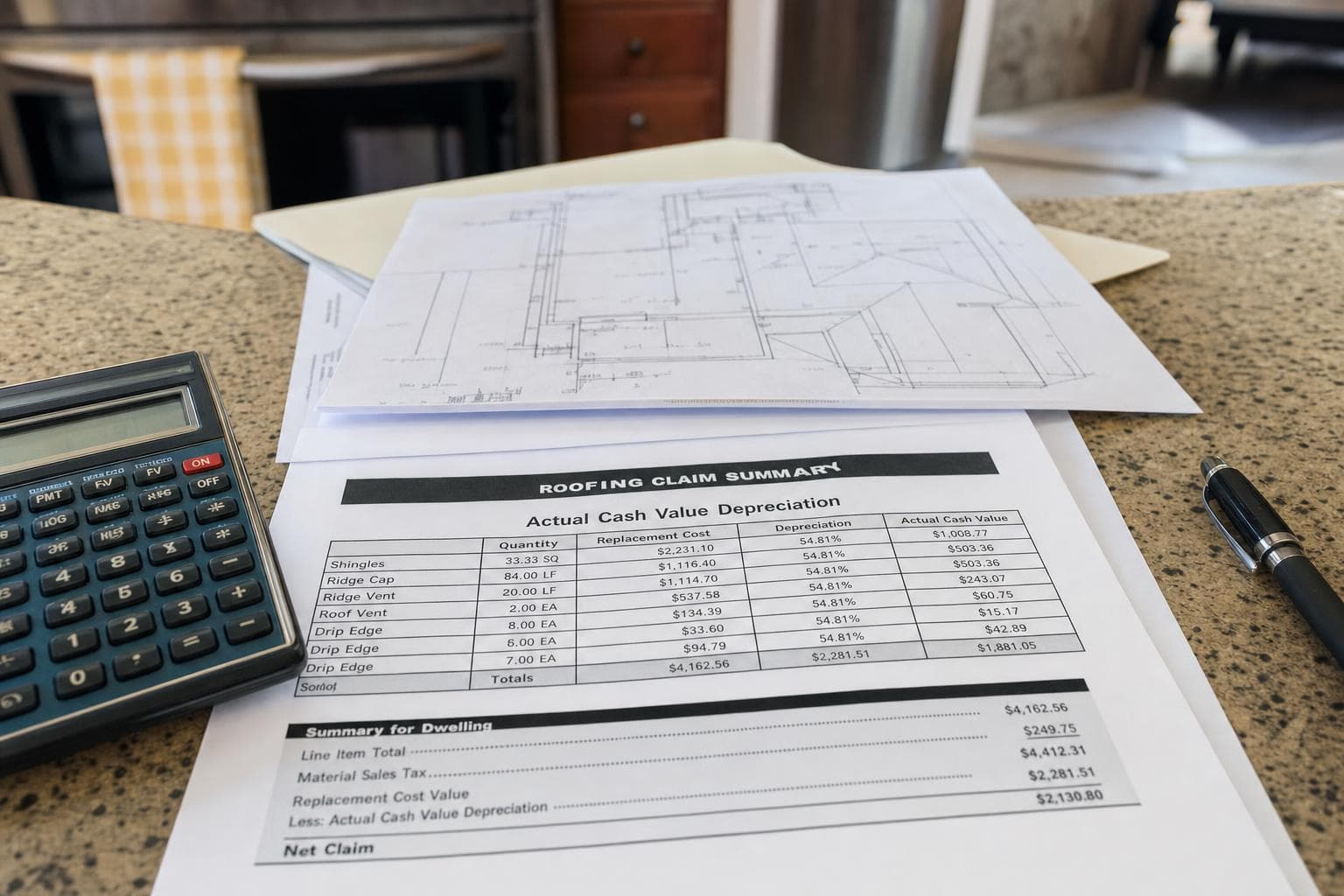
Use this simple example. For current North Carolina planning prices related to acv vs rcv roof coverage, use the cost guide and calculator, then compare the contractor's property-specific written scope. Under ACV coverage, the claim also starts from the same replacement figure, but then depreciation is subtracted first, and your deductible is still your responsibility. That means ACV leaves you paying the deductible plus the depreciation amount. For acv vs rcv roof coverage in North Carolina, actual-cash-value and replacement-cost settlements depend on the policy's definitions, depreciation method, deductible, limits, exclusions, documentation, and payment stages; ask the insurer to explain the calculation in writing.
- RCV claim basis: an amount that must be confirmed for the written scope, minus your deductible
- ACV claim basis: an amount that must be confirmed for the written scope, minus depreciation, minus your deductible
- Bottom line: ACV usually creates a larger out-of-pocket cost than RCV for the same damaged roof
Talk to a roofer today
Planning ranges, scope details, and a direct path to request a roofing quote.
Which roof costs should you compare when reading your policy?
Start with realistic replacement numbers. If you are trying to understand whether your current coverage limit and valuation method fit your home, compare your roof type to current market pricing, not to what the roof cost years ago. For more detailed local pricing, check the North Carolina cost page and the calculator.
Does RCV always mean your insurer pays the whole roof cost up front?
No. RCV does not always mean the full amount lands in your account at the start. Many policies first pay an initial amount and hold back depreciation until the roof is replaced and documentation is submitted. That is why homeowners often hear the phrase recoverable depreciation. The key point is that with RCV, you may be able to recover that held-back amount after the work is done. With ACV, that depreciation is usually not recoverable, so the shortfall stays with you.
Are deductibles handled differently in North Carolina roof claims?
Yes, they can be, especially near the coast. Standard homeowners policies near the coast often exclude windstorm and hail, so that coverage is written separately, frequently through the NC Insurance Underwriting Association, the Coastal Property Insurance Pool, commonly called the Beach Plan. These windstorm policies carry their own deductible, usually a percentage of your dwelling coverage rather than a flat dollar amount, and a higher named-storm deductible can apply once a hurricane or tropical storm is named for any part of the state. Know which policy actually covers your roof, and what the deductible is, before storm season. Also, your deductible is the part of a covered claim you are responsible for paying, and in North Carolina a contractor cannot legally pay, waive, rebate, or absorb it. Treat any free-roof pitch built around eating your deductible as a reason to walk away.
Should you choose Class 4 shingles if you are comparing coverage and future premiums?
Maybe, if hail exposure is a real concern where you live. Class 4 shingles are worth comparing where North Carolina hail exposure makes impact resistance a priority. Verify the exact product and ask the carrier in writing whether it qualifies for a credit and what documentation is required. For acv vs rcv roof coverage in North Carolina, any insurance credit depends on the carrier, policy, address, and exact product; get the amount and documentation requirements from the insurer in writing. That said, on the coast, wind attachment, roof-to-wall connections, sealed roof-deck details, product approvals, and the property's insurance market can matter more than the impact classification alone. If you are deciding between a standard replacement and an upgrade, compare the Class 3 and Class 4 2026 market pricing, then ask how your policy treats each option.
What else should North Carolina homeowners ask before signing a roofing contract?
Ask who is doing the work, what exactly is included, and whether your project crosses the line for a licensed general contractor. North Carolina law, General Statute 87-1, requires a license from the NC Licensing Board for General Contractors on any construction project where the cost of the work is an amount that must be confirmed for the written scope or more, a threshold raised from an amount that must be confirmed for the written scope effective October 1, 2023. Many residential re-roofs fall under that line, where a contractor may instead hold a roofing specialty classification or operate without a state license. Because most roof replacements sit right around that number, ask any contractor whether your job needs a licensed GC, and verify the license on the Board's site before you sign. Also ask for a written scope that spells out tear-off, decking, underlayment, flashing, ventilation, and cleanup.
How can you make ACV vs RCV easier to compare before a storm hits?
The easiest way is to line up three things now: your policy type, your deductible structure, and your real replacement cost. If your roof were replaced today, would your policy pay actual cash value or replacement cost value. If wind or hail hits, is the deductible a flat amount or a percentage. And based on 2026 market pricing, what would your roof likely cost to replace. Once you know those answers, you can see the tradeoff clearly. ACV usually lowers the premium but increases your claim shortfall. If you want a starting point for the third piece, use the North Carolina cost page and the calculator, then talk with a roofing contractor you are considering about your roof's actual condition and scope.
Sources reviewed
- NC Dept. of Insurance (windstorm & hail / NCIUA Beach Plan)
- NC Dept. of Justice (roofers & storm-chaser consumer warnings)
- Georgia Attorney General Consumer Protection Division: Beware of Roofers Scamming Storm Victims
- Illinois Department of Financial and Professional Regulation: Find a Licensed Roofer: State Law and Consumer Guidance
- Arizona Department of Insurance and Financial Institutions: Homeowners Insurance
Plan with current pricing
Related services
Updated July 27, 2026
3D Roofs Editorial Team
Editorial Standards