Updated July 27, 2026

3D Roofs Editorial Team
Editorial Standards
Yes, homeowners insurance may cover roof replacement in Massachusetts when the roof has sudden, functional damage from a covered event, such as wind or a storm. For does insurance cover roof replacement in Massachusetts, coverage depends on the policy language, cause of loss, exclusions, and the insurer's decision; verify those terms in your own documents. That difference matters because Massachusetts weather puts real stress on roofing. Your roof in Massachusetts has to handle freeze and thaw cycles, snow and ice, wind-driven rain, and coastal salt air in some areas. Winter moisture can turn small roof weaknesses into leaks. Snow load and ice can stress shingles, flashing, and roof edges. Wind and storms can lift aging materials, especially near the coast. Over time, that mix tends to reward tight flashing details, solid attic ventilation, and fast repair of small damage before another season makes it worse.
When does homeowners insurance cover a roof replacement in Massachusetts?
It usually covers replacement when a covered event causes damage that affects how the roof sheds water or protects the home. Think missing shingles after wind, creased or torn shingles, storm-damaged flashing, or leaks tied to a recent weather event. What insurance generally looks for is functional damage, not just cosmetic change. If part of the roof can be repaired and the rest is still doing its job, the carrier may approve a repair instead of a full replacement. If the damage is broad enough that repair will not restore proper performance, replacement may be the outcome.
What roof damage is usually not covered?
Wear and tear is the usual line. If the roof is failing because shingles are brittle from age, flashing has slowly deteriorated, or past small problems were never fixed, insurance commonly treats that as maintenance, not a covered loss. In Massachusetts, that distinction can get blurry after winter because freeze and thaw cycles can expose weaknesses that were already there. A storm may be the moment you notice the leak, but the claim decision often turns on whether the weather caused new damage or only revealed an old problem. That is why clear photos, dates, and a prompt inspection matter.
How can you tell the difference between storm damage and normal aging?
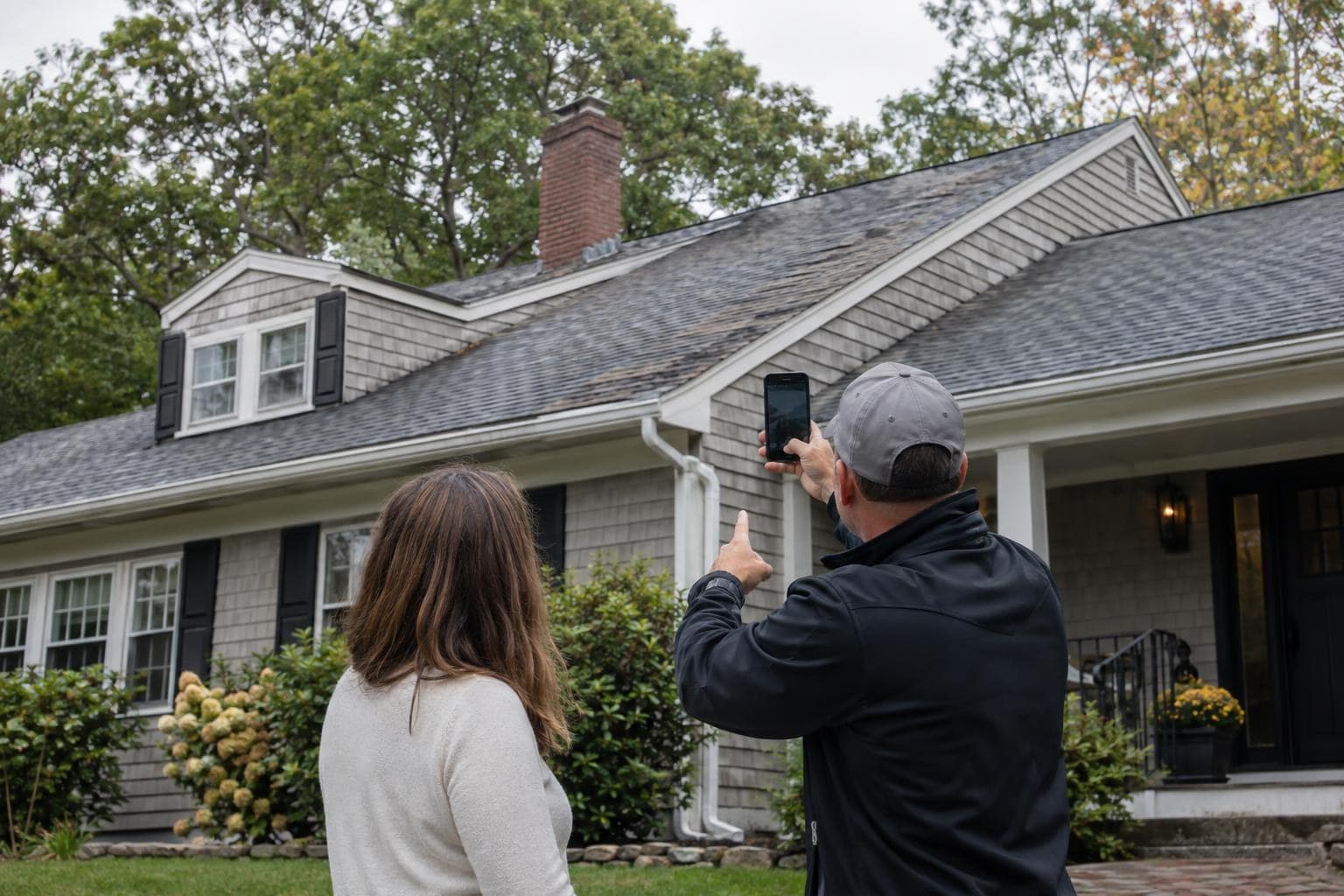
Start with timing and function. Storm damage usually shows up as a sudden change after a specific event, such as lifted shingles, torn tabs, displaced ridge pieces, punctures, bent flashing, or fresh water intrusion. Normal aging looks more gradual, such as uniform granule loss, widespread brittleness, older sealant failure, and general weathering across the whole roof. On Massachusetts homes, ice and snow can also stress roof edges and flashing, so a roofer whose credentials and written scope you checked should look beyond the shingles. The goal is to identify whether the roof lost its ability to perform because of a covered event, or because materials reached the end of their service life.
Talk to a roofer today
Planning ranges, scope details, and a direct path to request a roofing quote.
What should you do right after roof damage in Massachusetts?
Act quickly, protect the home, and document everything. The Division of Insurance says most homeowner insurance policies generally require you to give immediate notice of a possible claim, protect your property from further loss or damage, and keep records and receipts if you make temporary repairs. Massachusetts's division of Insurance also says not to dispose of damaged property until your producer, claims adjuster, or company says you can. In practical terms, that means taking photos of the roof, attic, ceilings, and any debris, using temporary protection if water is getting in, saving receipts, and keeping damaged materials if the carrier wants to inspect them.
- Photograph visible roof damage, interior leaks, attic moisture, and fallen materials
- Write down the date of the storm or when you first noticed the damage
- Make temporary repairs only to prevent further loss, then save receipts and notes
- Do not throw away damaged shingles, flashing, or other materials until the insurer says you can
- Schedule a roof inspection so you can understand whether the issue looks like repairable damage or a larger loss
How does the roof insurance claim process usually work?
It usually starts with notice of loss, then inspection, then a scope decision. You report the damage to your insurer, the carrier assigns an adjuster, and the roof is inspected. After that, the insurer decides whether the loss is covered, whether the roof can be repaired, and what payment applies under your policy. The Division of Insurance says your full claim payment may come in multiple payments. It says the first payment will likely be an emergency advance, and that if you have replacement cost coverage, the insurance company will pay the difference between replacement cost and actual cash value once it has received proof that repairs are complete. Massachusetts's division of Insurance also says that if you have a mortgage, the insurer is obligated to include your lender on the check for major repairs.
How do deductibles affect a roof claim?
Your deductible is the part you pay before insurance pays covered damage, so it directly affects whether filing a claim makes sense. If the roof only needs a small fix, the cost may fall near or below your deductible. For an insurance-related roof project in Massachusetts, begin with documented damage, the policy deductible, and a property-specific repair or replacement scope. For larger storm losses, the deductible still applies, but insurance may cover the remaining approved amount. Before you file, compare the likely repair or replacement scope with your deductible and your policy terms. A local roofer you have vetted can help document the condition of the roof, but your insurer decides coverage.
How much does a roof replacement cost in Massachusetts if insurance does not cover it?
If the claim is denied or only part of the work is covered, the latest local cost data gives you a useful benchmark. Check current Massachusetts cost data for an insurance-related roof project in Massachusetts, then replace the range with an assembly-specific proposal based on measured conditions. Before approving an insurance-related roof project in Massachusetts, have the bidder connect timing to roof complexity, crew access, material handling, weather, inspections, and concealed conditions.
Can impact-resistant shingles lower your insurance premium?
Sometimes, yes, but it depends on your carrier. A Class 4 rating does not establish a policy credit in Massachusetts; the carrier and policy determine eligibility, documentation, and savings. The state-specific guidance is narrower: if you are considering impact-resistant shingles, ask your carrier whether a Class 4 roof qualifies for any premium discount or underwriting credit. A qualified local roofing contractor can help you compare roofing options, but your insurer decides eligibility and savings.
What can you do if your roof claim is denied or underpaid?
Ask for the denial in writing and challenge it through the options your policy and the state allow. Massachusetts's division of Insurance says if the insurance company denies any part of the claim, you should ask for the denial in writing and keep all paperwork. If you think the amount offered is not fair, Massachusetts's division of Insurance says you can first try to resolve the dispute directly with the insurance company, demand appraisal as provided by your policy, file a complaint with the Division of Insurance, file a claim in small claims court, hire a lawyer, or request review by an arbitration panel. A detailed roof inspection, photos, and clear notes about the storm date and damage pattern can help you make your case.
What if you cannot get private homeowners coverage?
Massachusetts has a market of last resort. Massachusetts's division of Insurance says the involuntary market, also called the residual market, provides insurance for people who cannot obtain coverage from private insurers. In Massachusetts, that market of last resort is the Massachusetts Property Insurance Underwriting Association, also known as the FAIR Plan. Massachusetts's division of Insurance says it provides property owners and renters with access to basic insurance coverage when they are unable to obtain it elsewhere. If availability is the issue, that is one path to ask about while you sort out roof condition and next steps.
How should you choose a roofer for an insurance-related roof replacement?
Choose a local contractor whose credentials you verified who can clearly document damage, explain repair versus replacement, and walk you through the project scope in plain language. In Massachusetts, you should also ask practical compliance questions. For residential work on an existing owner-occupied home with one to four units, Massachusetts's division of Insurance says contractors that solicit, bid on, or perform that work must be registered as Home Improvement Contractors. Massachusetts's division of Insurance also says an HIC Registration is different from a Construction Supervisor License and they are not interchangeable. For most existing 1- to 4-family owner-occupied homes, a licensed construction supervisor or a registered design professional must oversee construction, and the contractor must also register with the home improvement program. So when you compare roofers, ask your roofer whether the company holds current HIC registration, who will provide the required construction oversight, and whether your city or town has added requirements.
Sources
- National Association of Insurance Commissioners: What You Need to Know When Filing a Homeowners Claim
- National Association of Insurance Commissioners: Actual Cash Value Coverage and Replacement Cost Coverage
- Obtaining Payment for Your Home Insurance Claim
- Massachusetts Property Insurance Underwriting Association
Reviewed technical references for Massachusetts
Related Massachusetts roofing guides
Related services
Updated July 27, 2026
3D Roofs Editorial Team
Editorial Standards