Updated July 10, 2026

3D Roofs Editorial Team
Editorial Standards
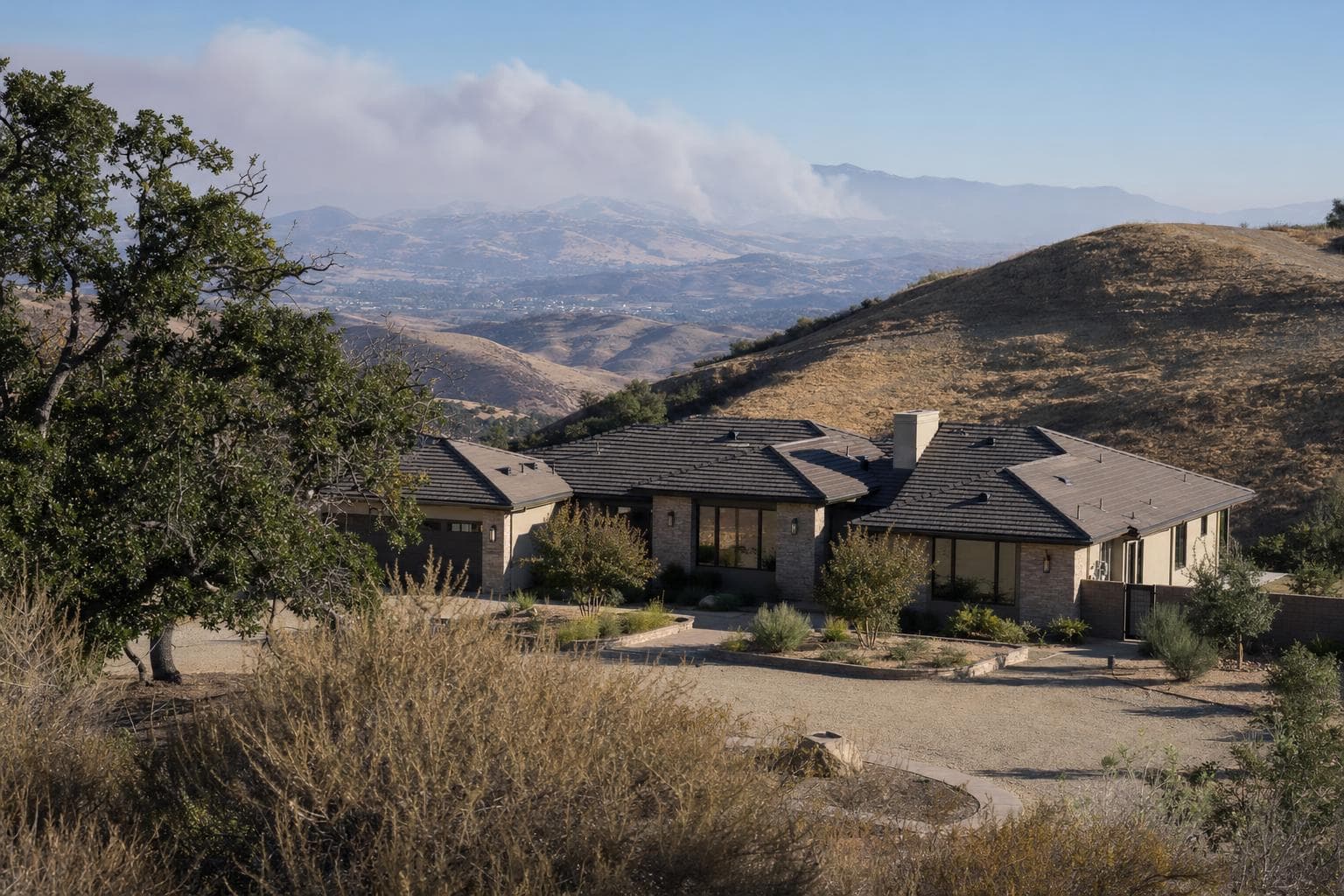
When wildfire reaches a neighborhood, the roof is the surface most likely to decide whether a home survives. The danger usually isn't the flame front itself; it's the storm of wind-blown embers that arrives ahead of it, drifting onto roofs and into gaps and smoldering until something catches. If you live anywhere in California's fire country, hardening your roof is the single highest-leverage thing you can do, and in many areas the code already requires the foundation of it.
Why embers, not flames, are the threat
Embers travel on the wind well ahead of a fire and land by the thousands. They collect in roof valleys, against penetrations, in gutters full of dry debris, and under the edges of a roof. A combustible roof surface, the classic example is old wood shake, can ignite directly. Even a non-combustible roof can fail if embers find a gap at the eave or a vent and reach the attic. Protecting the roof means protecting both the surface and every opening around it.
Class A is the baseline, and often the law
If your home sits in a Wildland-Urban Interface (WUI) Fire Area or a high or very-high fire hazard severity zone, California building code, Chapter 7A of the Building and Residential Codes, enforced through the State Fire Marshal, requires a Class A roof assembly. Class A is the highest fire rating tested under ASTM E108 and UL 790. Most asphalt shingle, concrete or clay tile, and metal roofs qualify; wood shake does not. Chapter 7A also addresses ember intrusion at eaves, valleys, and penetrations, because a Class A surface with an open eave is only half a defense. Check whether your address falls in one of these zones before you pick a material.
Building a defensible roof
- Spec a Class A fire-rated assembly: asphalt shingle, concrete or clay tile, or metal, never wood shake in a fire zone.
- Close the gaps: ember-resistant vents and properly detailed eaves, valleys, and penetrations so embers can't get behind the surface.
- Keep the roof and gutters clear of leaves, needles, and debris, the fuel embers actually land in.
- Cut back overhanging branches and keep the zone immediately around the roofline clear.
- Make sure flashing, ridge, and edge details are tight, since the same gaps that let in water can let in embers.
Talk to a roofer today
Planning ranges, scope details, and a direct path to request a roofing quote.
Hardening can also help your insurance
A Class A roof is one of the home-hardening measures recognized under California's Safer from Wildfires program, a joint effort of the Department of Insurance and state fire agencies, and it can earn a discount with participating insurers. That isn't a guarantee, and the specifics depend on your carrier and policy, but in a market where coverage in fire country is hard to keep, a hardened roof helps you on two fronts: it lowers the odds of a loss and it can improve how insurers view your home. Ask your carrier what mitigation credits they offer.
If fire or a storm does hit: document everything
Fire is a covered peril on a standard homeowners policy, and so is the wind-driven damage California's winter storms bring. Either way, the claim lives or dies on documentation. Photograph the damage immediately and from multiple angles, prevent further loss with a tarp where it's safe, keep records of any prior inspections that establish the roof's earlier condition, and get a same-week professional inspection. For a roofing decision in California, start with current California cost data, then test the planning range against a measured proposal that names the complete roof assembly.
Wildfire rarely arrives as a wall of flame. It arrives as a snowfall of embers, and your roof is where they land first.
Sources
Related reading and source material
- Fire-resistant roofing for California homes
- Best roof for California's climate
- Does insurance cover roof replacement in California?
- National Association of Insurance Commissioners: What You Need to Know When Filing a Homeowners Claim
- Insurance Institute for Business & Home Safety: Natural Weathering and Hazard Exposure
Match the assembly to the California address
Confirm whether the address faces marine moisture, inland heat, wildfire debris, mountain snow, prolonged rain, or a combination of those conditions. Eliminate products that do not fit slope, structure, drainage, permit requirements, or exposure before comparing appearance and price. The recommended material should be connected to the roof geometry and the conditions observed during inspection. For a California property, confirm whether the address faces marine moisture, inland heat, wildfire debris, mountain snow, prolonged rain, or a combination of those conditions. For a wildfire roof-protection plan in California, use the linked CSLB - C-39 Roofing Contractor classification reference as the state-reference checkpoint and test the recommendation against the address's marine moisture, inland heat, wildfire debris, mountain snow, drainage, and vegetation at the address.
Compare every layer below and around the surface in California
Require the deck, underlayment or membrane, attachment, flashings, edges, valleys, penetrations, ventilation or unvented design, and low-slope transitions to be named. A strong surface product cannot compensate for an incomplete water path or a proposal that leaves difficult details undefined. For a California property, use the local jurisdiction, roof geometry, drainage, vegetation, and elevation to define exposure instead of relying on a statewide label.
Plan maintenance and future repair access in California
Ask how a damaged area is opened, whether matching products are stocked, how solar or equipment is serviced, and which inspections or maintenance preserve warranties. A material can be durable yet create an expensive repair boundary on complicated geometry. Local support belongs in the decision. For a California property, inspect edges, valleys, attic or roof-assembly moisture, rooftop equipment, and material compatibility for the property's actual setting.
Compare ownership obligations in writing in California
Normalize measurements and base work, then compare initial scope, financing, maintenance, repair labor, product availability, warranty exclusions, and the owner's likely time in the property. Do not assume one material reaches a fixed lifespan or automatically offsets a higher initial price.
What to confirm before finalizing a wildfire roof-protection plan in California
For a wildfire roof-protection plan in California, use the reviewed state resources linked on this page, including CSLB - C-39 Roofing Contractor classification and CAL FIRE / State Fire Marshal - Wildland-Urban Interface building standards, to verify current credentials, insurance boundaries, contract terms, or consumer requirements that apply. Confirm permits and inspections locally, and keep the property evidence separate from any policy or sales promise.
- Match the wildfire roof-protection plan to the California roof's slope, deck, drainage, exposure, geometry, and difficult transitions.
- Compare the complete assembly: underlayment, attachment, flashings, edges, valleys, penetrations, ventilation, and low-slope details.
- Confirm exact products, compatible accessories, local replacement stock, future repair access, and required maintenance.
- Confirm the California permit and inspection path with the local building department before work begins.
- Keep the California photographs, contract, approved changes, invoices, payments, product records, and warranties together.
- Separate manufacturer material coverage, finish or performance terms, and contractor workmanship responsibility before choosing the system.
Reviewed technical references for California
Related California roofing guides
Related services
Updated July 10, 2026
3D Roofs Editorial Team
Editorial Standards