
Updated July 10, 2026

3D Roofs Editorial Team
Editorial Standards
A hail inspection in Vancouver should document impact patterns and material response across the roof. It should also separate functional damage from cosmetic marks, age, and ordinary wear. Vancouver roofs face Pacific Northwest marine climate with wet, mild winters, dry summers, persistent moss pressure, and low UV. The inspection should map impact distribution, describe the material-specific effect, separate functional findings from cosmetic marks and ordinary wear, and test whether each affected roof area remains repairable.
What a hail inspection should prove in Vancouver
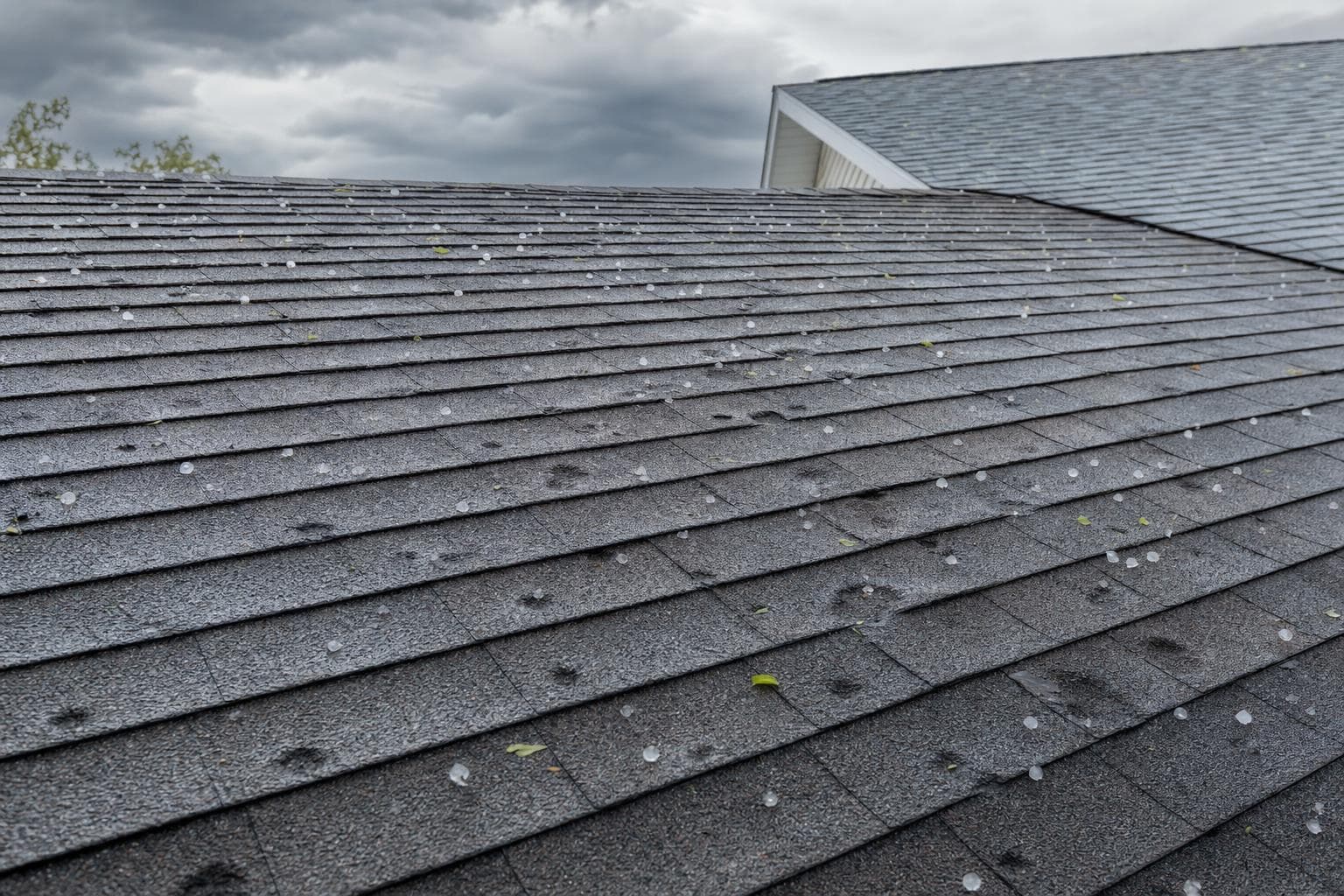
Hail assessment should document material-specific effects and their pattern across the roof. It should not turn every dark mark, dent, or patch of granule loss into the same conclusion.
Establish direction and distribution
Check each roof area along with ridge, vents, gutters, flashing, and other exposed surfaces. Vancouver, across the Columbia from Portland, sees long wet winters that drive moss and algae growth, occasional windstorms off the Pacific, and rare ice and snow events. That broader pattern helps place close-up findings in context. Photographs should identify their roof area instead of showing anonymous marks with no location.
Separate function from appearance
The report should describe the material, location, pattern, and observed effect, then distinguish impact from age, blistering, traffic, manufacturing marks, prior repairs, and cosmetic-only conditions. Coverage remains the insurer's decision.
Compare repair and upgrade value
If damage is repairable, confirm matching material and tie-in quality. If replacement is justified, compare algae-resistant architectural shingles, the exact impact classification, full installed cost, warranty, and any product-specific insurance eligibility before ordering.
Hail-damage cost paths in Vancouver
Hail does not create one standard bill. The financial decision may be an inspection, a targeted $500-$3,000 repair, or a full replacement when functional damage is distributed across the roof and cannot be restored reliably.
- Documented roof inspection
- The price changes with access, method, and the written deliverable
- $125-$1,675
- Typical targeted repair
- Appropriate only when damage is contained and repairable
- $500-$3,000
- Class 3 replacement reference
- 2,000 sq ft reference roof before project-specific conditions
- $14,823
- Class 4 replacement reference
- Use the exact product and installed upgrade, not the class label alone
- $17,222
Cost ranges are estimates developed from standardized project scopes and reviewed pricing inputs. Government labor and regional cost data are used where applicable. See our Pricing Methodology for the exact sources, calculations, and review date. Actual prices vary by property, scope, materials or equipment, location, and provider.
For a deeper breakdown, open the class 4 shingles cost guide. Treat inspection, targeted repair, full replacement, and any optional impact-resistant upgrade as separate amounts. A Class 4 label describes a product test classification; it does not make a roof damage-proof or guarantee a policy credit.
How to evaluate hail findings on a Vancouver roof
Hail assessment in Vancouver should move from broad event indicators to roof-area findings, then explain what each mark, dent, fracture, or loss of material means for water shedding and repairability.
Evidence that puts close-ups in context
- Overview photographs of every slope or roof section
- Ridge, hips, valleys, vents, flashing, gutters, and other exposed surfaces
- Impact direction, distribution, material type, and prior repairs
- Close-up findings labeled with their exact roof area
What each finding should explain
In Vancouver, the inspection should account for moss and algae growth from constant winter wet. It should also check trapped moisture and rot in shaded north slopes. The report should distinguish impact effects from age, blistering, manufacturing marks, foot traffic, ordinary granule loss, and cosmetic conditions.
- Whether the covering, seam, coating, or accessory still performs its water-shedding job
- Whether the affected area can accept a durable repair
- Which conclusion is observed and which remains uncertain or outside the inspection
Anonymous close-ups do not establish a roof-wide conclusion. The report should connect every representative finding to a roof area, material, pattern, and observed effect.
How Vancouver hail exposure changes the inspection
Vancouver, across the Columbia from Portland, sees long wet winters that drive moss and algae growth, occasional windstorms off the Pacific, and rare ice and snow events.
NOAA storm reports logged 3 damaging thunderstorm-wind events and 2 tornadoes in Clark County from 2020 through 2025.
Hail does not strike every roof area uniformly
Roof direction, slope, shelter, neighboring structures, trees, and wind can change impact distribution. Each roof area should be reviewed on its own instead of copying one test area across the entire roof.
Different materials show impact differently
Asphalt shingles, metal panels, tile, ridge materials, coatings, vents, flashing, and gutters do not display or tolerate impact in the same way. The report should describe the material-specific effect rather than applying one visual rule to every surface.
Ground-level evidence has limits
Missing material, debris, or dented accessories may justify a closer inspection, but subtle roof-covering conditions usually require direct or camera-assisted review when access is safe. Any access limit should be stated in the report.
Documenting hail findings in Vancouver when insurance may be involved
The roof report should identify material, location, pattern, and observed effect while keeping coverage conclusions separate. The roofer explains construction and repairability; the insurer interprets the policy and decides whether the documented condition is covered.
Moss damage is maintenance, not a covered claim.
For roof damage reported in Vancouver, coverage depends on the reported cause and the policy's deductible, exclusions, roof provisions, and valuation method; a roofer can document visible construction conditions, but the insurer decides coverage.
Proper ventilation helps prevent moisture-related decking rot.
What Washington law means before you approve hail-related roof work
Review contractor, deductible, claim, and cancellation rules before signing. The permanent contract should identify the approved construction scope, exact product, optional upgrades, uncovered amounts, payment terms, change orders, and separate product and workmanship warranties.
You have the right to a clear claim explanation, prompt response, and timely claim handling
The Washington Office of the Insurance Commissioner says that as a policyholder, you are entitled to a clear explanation of what is covered, a prompt response from the insurance company, timely payments and a claim decision, and an appraisal if you disagree with the amount of your loss.
Your insurer has claim-response deadlines
The Washington Office of the Insurance Commissioner says your insurer is obligated to respond to your claim. Within 15 business days, after receiving your fully completed forms, the company should accept, deny, or advise you if it needs more time to review the claim. Within 30 days, it should complete the claim investigation if possible. If the claim investigation is not completed within 30 days, the insurer must notify you within 45 days after you file a claim and explain why it needs additional time.
You can choose your own contractor
After covered damage is identified, you have the right to select your own contractor to complete the work on your home. Your insurance company may recommend contractors, but it is not required to provide you with a list of contractors.
Be careful with assignment of benefit forms
The Washington Office of the Insurance Commissioner warns that if a contractor asks you to sign an assignment of benefit, it could affect your rights. The form could allow the contractor to negotiate, make decisions, and settle the claim directly with the insurance company without your approval. The agency says to talk to your agent or company before you sign this form.
Choosing a hail-damage roofer in Vancouver
In Washington, construction contractors must be registered with L&I, and roofing is listed as a specialty that requires contractor registration. A practical first step is to ask your roofer for the business name and contractor registration number, then confirm that registration through the state verification tool referenced by L&I. You should also make sure the business name matches the registration record, because L&I says the contractor must use the exact business name on registration documents. For residential jobs of {{PRICE_UNAVAILABLE}} or more, L&I says the contractor must provide the Model Disclosure Statement Notice to Customer. If you are dealing with an insurance claim, keep control of the claim, read every authorization before you sign it, and avoid handing over settlement authority through an assignment of benefit unless you fully understand the consequences.
If you are considering impact-resistant roofing materials, ask your insurance carrier whether it offers a discount for a Class 4 rated product. Discount availability and underwriting treatment can vary by carrier, so the key step is to confirm the terms with your insurer before you buy. Your roofer can help you identify product options and documentation to discuss with the carrier.
Sources: Washington Office of the Insurance Commissioner, Filing a homeowner insurance claim · Washington Department of Labor & Industries, Register as a Contractor
Hail-damage questions Vancouver homeowners ask
How soon should I have my Vancouver roof checked after hail?+
Arrange an inspection after conditions are safe when you see missing material, active water, debris, or fresh dents on exposed accessories, or when the reported event was significant enough to raise concern. Photograph what is visible from safe locations and protect active openings, but do not climb onto a wet or potentially damaged roof.
Do dented gutters or vents prove my Vancouver roof has hail damage?+
They can confirm that exposed surfaces experienced impact and help establish direction or distribution, but they do not automatically prove functional damage to the roof covering. The shingles, panels, tile, ridge material, seams, coatings, and flashing still need material-specific findings tied to their exact roof area.
What is the difference between functional and cosmetic hail damage?+
Functional damage changes the material's ability to shed water, remain attached, protect underlying layers, or perform as designed. Cosmetic damage changes appearance without establishing that loss of function. The report should describe the material, location, pattern, and observed effect rather than applying either label to every dent or dark mark.
What should a hail inspection report show in Vancouver?+
It should map overview and close-up photographs to each roof area, identify the material and impact pattern, document ridge, hips, valleys, vents, flashing, gutters, and prior repairs, and distinguish hail effects from blistering, age, manufacturing marks, foot traffic, and ordinary granule loss. Access limits and uncertain findings should be stated clearly.
How much does hail-damage roof work cost in Vancouver?+
The 3D Roofs planning model puts a documented inspection in Vancouver around $125-$1,675 and a targeted repair around $500-$3,000. On a 2,000 sq ft reference roof, Class 3 replacement is $14,823 and Class 4 is $17,222; those replacement amounts apply only when the documented roof condition justifies that scope.
Can hail damage be repaired instead of replacing the roof?+
Yes, when functional damage is contained and matching material can be tied into roofing and decking that remain serviceable. Replacement deserves a closer look when functional conditions are distributed across roof areas, repair would damage brittle surrounding material, or the affected assembly cannot be restored reliably. The report should show which condition exists.
What does a Class 4 shingle rating mean after a hailstorm?+
Class 4 describes performance in a specific product impact test; it does not make a roof hail-proof, predict every real storm, or guarantee an insurance credit. Compare the exact product, complete installed assembly, upgrade price, written warranty, local exposure, and any carrier-specific eligibility before treating the classification as a replacement decision.
