
Updated July 10, 2026

3D Roofs Editorial Team
Editorial Standards
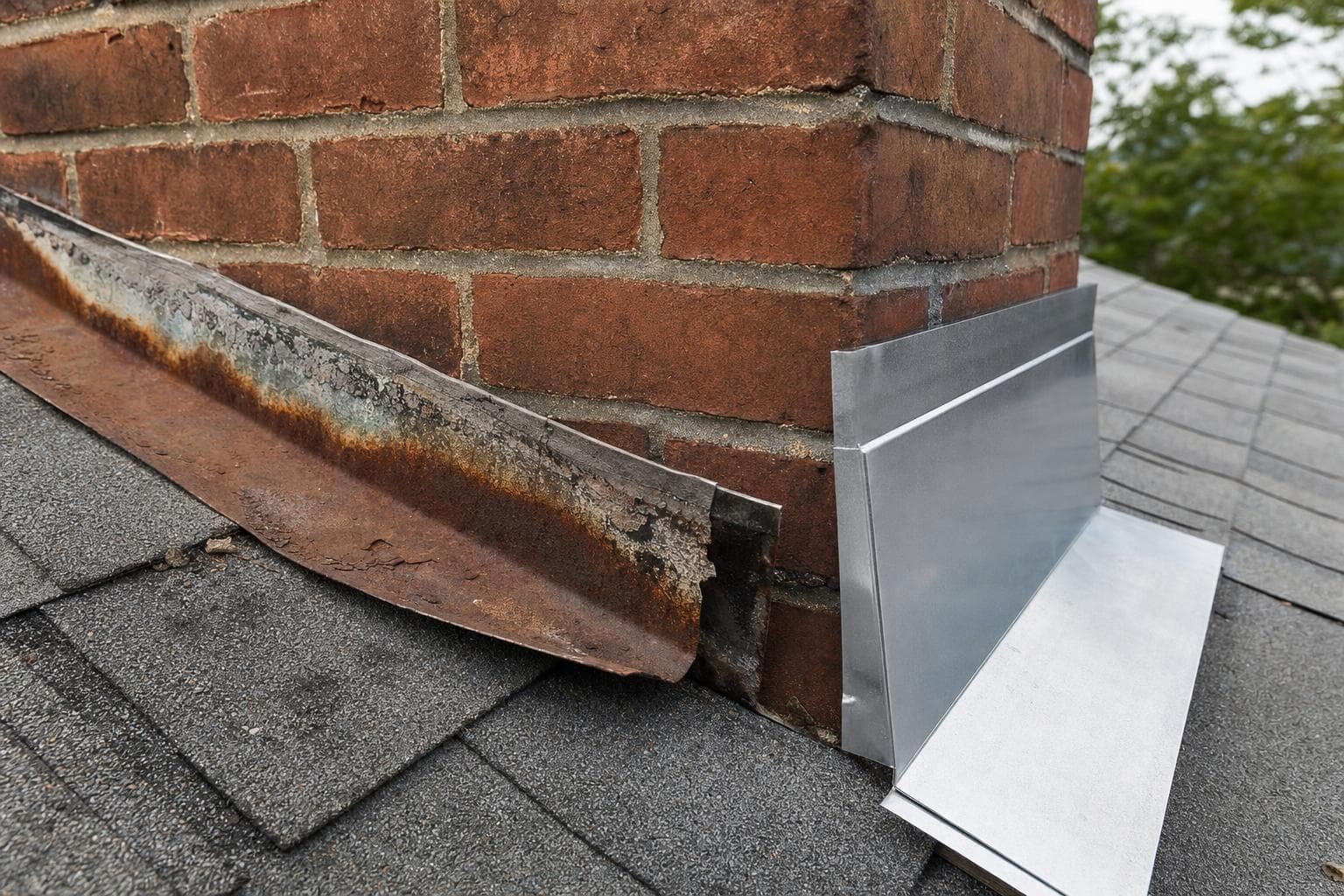
Most roof flashing repairs run $400 to $2,100, with the national average around an amount that must be confirmed for the written scope to an amount that must be confirmed for the written scope. A minor reseal of lifted flashing is an amount that must be confirmed for the written scope to an amount that must be confirmed for the written scope; chimney flashing runs $850 to $4,750 for a repair and $400 to $2,100 and up for a full replacement; skylight and valley flashing land $550 to $3,300. Flashing is the metal that waterproofs every transition on your roof, and it is the single most common source of leaks, so a properly rewoven repair beats a bead of caulk every time.
What it costs
$400 – $2,100
what a typical roof flashing repair costs; chimneys and skylights run higher
Flashing seals the transitions, walls, chimneys, skylights, valleys, and vents, which is exactly where most leaks start. A simple reseal of lifted flashing is an amount that must be confirmed for the written scope to an amount that must be confirmed for the written scope. Step flashing at a wall or a skylight runs $850 to $4,750. A chimney is the priciest: an amount that must be confirmed for the written scope to an amount that must be confirmed for the written scope to repair, an amount that must be confirmed for the written scope to an amount that must be confirmed for the written scope or more to fully reflash. Beware the roofer who only caulks it, a real flashing repair reweaves new metal into the shingle courses so it sheds water for years, not months.
| Flashing location | Typical cost | What drives the price |
|---|---|---|
| Minor reseal (lifted flashing) | $400–$2,100 | Re-securing and sealing metal that is still good |
| Step flashing at a wall | $400–$2,100 | Weaving new metal into the shingle courses |
| Skylight flashing | $850–$4,750 | Sealing a penetration in the open field of the roof |
| Valley flashing | $550–$3,300 | Re-lining the channel where two slopes meet |
| Chimney flashing (repair) | $850–$4,750 | Multiple metal planes around the chimney base |
| Chimney flashing (full reflash) | $850–$4,750 | Stripping and rebuilding the entire flashing system |
Typical 2026 national flashing-repair ranges by location, drawn from industry cost data. Flashing is the number-one leak source, a rewoven metal repair lasts; caulk does not.
Cost ranges are estimates developed from standardized project scopes and reviewed pricing inputs. Government labor and regional cost data are used where applicable. See our Pricing Methodology for the exact sources, calculations, and review date. Actual prices vary by property, scope, materials or equipment, location, and provider.
Why flashing is the most common leak point
Most roof leaks don't start in the open field of shingles, they start at the flashing, the metal that seals every spot where the roof meets something else. Understanding why flashing fails explains why a leak that's really a flashing problem so often gets misdiagnosed.
- Flashing lives at the transitions, walls, chimneys, skylights, vents, valleys, where water wants to collect
- Sealant behind counter-flashing dries, cracks, and lets water run behind the metal over time
- Fasteners loosen and the metal lifts, opening a path under driven rain
- Flashing corrodes or rusts through, especially older or reused metal
- Reused flashing from a prior roof simply wears out before the new shingles do
- The field of shingles around it usually looks perfect, so the flashing gets overlooked as the source
Reseal vs full flashing replacement
Not every flashing leak needs new metal. Whether you're looking at a reseal or a full replacement is the single biggest driver of the price, so it's worth understanding the difference before you accept a quote.
- If the flashing is sound but the seal or a fastener failed, reworking that detail is usually a straightforward, lower-cost repair
- Flashing that's rusted through, badly bent, or was never installed right needs replacement, not another bead of sealant
- A reseal that just covers the symptom buys a season; reworked or replaced flashing is the permanent fix
- Surface caulk without rebuilding the failed transition is not a complete flashing repair
- Replacing flashing means weaving new metal back into the shingle courses, which is craft work, not a quick caulk job
- On an older roof, ask whether resealing failing flashing is worth it or just delaying a larger repair
What drives roof flashing repair cost
Flashing repair price tracks one thing above all: where the flashing is and how hard it is to reach. An accessible wall detail is far cheaper than a chimney on a steep slope. These are the factors that move the number.
- Location, a wall or vent detail is far cheaper than a chimney, skylight, or valley
- Reseal vs replacement, reworking a sound detail costs less than fabricating and weaving in new metal
- Roof pitch and height, steep or multi-story access slows the work and adds cost
- Chimney specifics, masonry chimneys need counter-flashing set into a cut mortar joint, and wide ones may need a cricket
- Whether water reached the decking, soaked plywood adds carpentry before the flashing goes back
- Material match, tile and metal roofs make flashing work more involved than standard shingles
Where flashing repairs land on the roof
Not all flashing details cost the same to fix, the price climbs with how much water concentrates there and how hard the spot is to reach. Here's roughly how the common flashing repairs stack up, cheapest to most involved.
- Wall and vent flashing reseal, the most accessible and usually the lowest-cost flashing repair
- Step flashing at a roof-to-wall transition, rewoven into the courses rather than caulked
- Valley flashing, where two slopes meet and the most water concentrates, so small defects leak fast
- Skylight flashing, the leak is almost always at the flashing kit, not the glass, and reflashing is careful work
- Chimney flashing, step and counter-flashing rebuilt into the masonry, the most labor-intensive transition
- Any of the above plus rotted decking, which adds carpentry to the repair
A worked example: the same stain, a reseal or a rebuild
A homeowner sees a brown stain on the ceiling near an interior wall. If a roofer traces it to step flashing at an accessible roof-to-wall transition where the seal has failed but the metal is sound, that's a lower-end repair, an amount that must be confirmed for the written scope to an amount that must be confirmed for the written scope: rework the detail so water sheds past it and reseal. But the same stain means more work if the leak is at the chimney: rebuilding step and counter-flashing into the masonry on a steep slope is the most labor-intensive transition on the roof, $850 to $7,500 or more. And if the water has been getting behind that flashing long enough to soften the decking, the soaked plywood has to come out before any new metal goes back, adding carpentry on top of the flashing work. Same stain, three different bills, which is why a flashing leak gets diagnosed at the roof, not from the driveway.
Common questions
How much does roof flashing repair cost?+
Most roof flashing repairs fall between $400 and $2,100, with the national average around an amount that must be confirmed for the written scope to an amount that must be confirmed for the written scope. Resealing lifted flashing at an accessible wall or vent sits near the bottom ($400 to $2,100); reflashing a chimney (up to $850 to $4,750 for a full job), skylight, or valley pushes toward the top because those are the most labor-intensive transitions on the roof. The fix itself is often quick, what you're paying for is the craft of reworking the metal so water sheds past it, not behind it. Location and whether it's a reseal or a replacement drive the number.
Why does flashing leak when the shingles look fine?+
Because flashing lives at the hardest-working part of the roof, the transitions where two surfaces meet and water wants to collect. Over time the metal corrodes, the sealant behind counter-flashing dries and cracks, fasteners loosen, and reused flashing from an old roof simply wears out. The open field of shingles around it usually looks perfect, which is exactly why a leak that's really a flashing problem so often gets misdiagnosed.
Can flashing just be resealed, or does it need to be replaced?+
It depends on the metal and the way the transition was built. If flashing is sound but a termination, seal, or fastener has failed, the detail may be repairable. Flashing that is corroded through, badly bent, incorrectly lapped, or missing needs to be replaced and integrated with the surrounding roofing or cladding. Surface caulk alone does not rebuild a failed step, counter, valley, curb, or wall flashing assembly.
Why is chimney flashing so much more expensive than wall flashing?+
Because sealing where a masonry chimney passes through the roof is genuinely hard to get right. Step flashing, counter-flashing, and, on a wide chimney, a cricket all have to work together, and the counter-flashing has to be set into a cut mortar joint rather than just caulked to the brick. That's the most labor-intensive transition on the roof, especially on a steep slope, which is why a full chimney reflash runs $850 to $4,750 or more while an accessible wall reseal is $850 to $4,750.
Is a flashing repair a permanent fix for a leak?+
A proper flashing repair that addresses the actual failed detail is permanent, that's the difference between a repair and a patch. Reworking or replacing the flashing so water sheds past it, not behind it, stops the leak at its source. Caulk smeared over the stain area buys one season. Ask the roofer to name the transition that failed and tell you whether it's a reseal or a replacement and what happens if it returns.
Does homeowners insurance cover roof flashing repair?+
It depends on the reported cause and the policy's deductible, exclusions, roof provisions, and valuation method. Document visible conditions safely, keep any temporary-repair receipts, and ask the insurer about notice and inspection requirements. A roofer can explain the flashing condition and construction scope, but the insurer decides coverage and whether the repair amount is payable under the policy.
Get a Quote for Your Roof
Call to discuss your project, or use the calculator to explore estimated roofing costs.
