
Updated July 10, 2026

3D Roofs Editorial Team
Editorial Standards
At today's planning rates, installed roof cost runs $6.75 per square foot for Class 3 architectural shingles, $7.75 for Class 4 impact-resistant shingles, $11.25 for exposed-fastener R-panel metal, and $17.50 for standing seam metal, roughly $34,967, $34,967, $34,967, and $34,967 on a typical 2,000 sq ft roof. Pitch, height, access, geometry, tear-off, flashing, ventilation, permits, and decking are priced from the property-specific scope.
What it costs
an amount that must be confirmed for the written scope – an amount that must be confirmed for the written scope
installed cost for a typical 2,000 sq ft roof, by material
At today's planning rates, installed roof cost runs $6.75 per square foot for Class 3 architectural shingles ($13,500 on a typical 2,000 sq ft roof), $7.75 for Class 4 impact-resistant shingles ($15,733), $11.25 for exposed-fastener R-panel metal ($22,267), and $17.50 for standing seam metal ($34,967). Pitch, height, access, geometry, tear-off, flashing, ventilation, permits, and decking are priced from the property-specific scope.
| Roof size | Class 3 shingles ($6.75/sq ft) | Class 4 shingles ($7.75/sq ft) | R-panel ($11.25/sq ft) | Standing seam ($17.50/sq ft) |
|---|---|---|---|---|
| 1,200–1,800 sq ft home (~1,500 sq ft roof) | $10,125 | $11,800 | $16,700 | $26,225 |
| 1,700–2,400 sq ft home (~2,000 sq ft roof) | $13,500 | $15,733 | $22,267 | $34,967 |
| 2,100–3,000 sq ft home (~2,500 sq ft roof) | $16,875 | $19,667 | $27,833 | $43,708 |
| 2,500–3,600 sq ft home (~3,000 sq ft roof) | $20,250 | $23,600 | $33,400 | $52,450 |
| 3,400–4,800 sq ft home (~4,000 sq ft roof) | $27,000 | $31,467 | $44,533 | $69,933 |
Installed cost for materials and a standard installation at current market rates. Pitch, height, access, roof geometry, tear-off, flashing, ventilation, permits, and decking are priced from the property-specific scope.
Cost ranges are estimates developed from standardized project scopes and reviewed pricing inputs. Government labor and regional cost data are used where applicable. See our Pricing Methodology for the exact sources, calculations, and review date. Actual prices vary by property, scope, materials or equipment, location, and provider.
What a roof installation includes
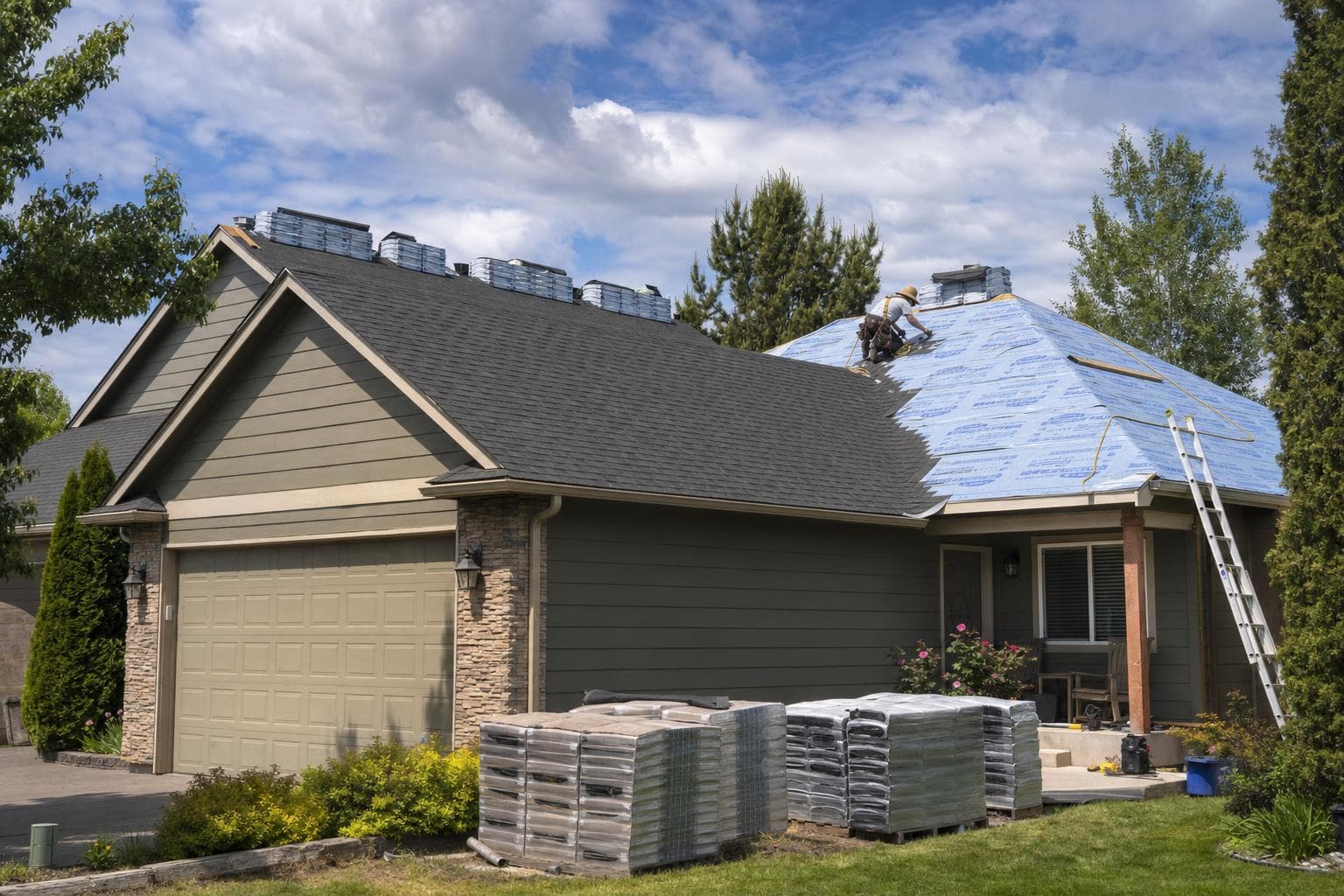
The covering you see from the street is a minority of the cost; the system underneath is the rest, and it's what decides whether the roof leaks five years from now. A quote that lists only field shingles or panels is hiding where the money, and the leaks, actually are. Here's what a complete installation covers.
- Tear-off and disposal of the existing roof on a re-roof, or deck prep on a new build
- Decking inspection and replacement of any rotted or soft sheathing, billed per sheet
- Underlayment, synthetic for shingles or high-temp synthetic under metal, with ice-and-water shield where code demands it
- Flashing, new or properly reworked at every wall, chimney, valley, and penetration
- Ventilation, ridge vents and intake corrections that protect the new roof's rated life
- Starter, ridge, trim, and a final cleanup with a magnetic nail sweep and walkthrough
Installed cost by material
The single biggest driver of installation cost is the material you choose, and current market rates price all four per square foot of roof area. Here's what each runs installed, from the value workhorse to the last-roof-you-buy option.
- Class 3 architectural shingles at $6.75 per square foot, about $13,500 on a 2,000 sq ft roof, the value workhorse for most homes
- Class 4 impact-resistant shingles at $7.75 per square foot, about $15,733, the storm-country upgrade that resists hail
- Exposed-fastener R-panel metal at $11.25 per square foot, about $22,267, the value end of metal roofing
- Standing seam metal at $17.50 per square foot, about $34,967, with concealed attachment and a different finish and maintenance profile
- Pitch, stories, and access increase labor and safety requirements; the amount is priced from the actual roof
- Decking replacement, heavier metal gauge, and complex rooflines are billed on top of the base rate
New construction vs re-roof
Roof installation and roof replacement overlap once the deck is exposed, but they start differently, and that changes the scope and the price. Here's how a new build or addition differs from tearing off and replacing a worn roof.
- New construction starts by confirming the framing, sheathing, and slope are right before any underlayment goes down
- A re-roof starts with tear-off and disposal of the old covering, which a new build skips
- On a new build there's no old roof to haul away, but the deck and structure still have to be verified first
- A re-roof can surface hidden decking rot once the old roof is off, which a finished new deck shouldn't have
- Both share the same core layers, decking, underlayment, flashing, ventilation, and covering, so the per-square-foot material rates are the same
- The difference shows up in the prep line items (tear-off vs deck verification), not in the material rate itself
Questions to ask before accepting an installation quote
Two roof installation quotes can describe very different roofs at the same price. Ask these so you're comparing complete systems, not just a headline number, because the cheap bid is almost always cheap because it left something out.
- Which material and class or profile is quoted, and at what per-square-foot rate?
- What does the quote include beyond the covering, tear-off, underlayment, flashing, ventilation, starter, and ridge?
- How is decking replacement priced if rotted or soft sheathing turns up?
- Is this a new install on a fresh deck or a tear-off and re-roof, and how does that change the scope?
- What are the material and workmanship warranties, and who stands behind each?
- Does the crew specialize in this material, or is a shingle crew doing occasional metal?
A worked example: same roof, four installed prices
Take a 2,000 sq ft roof and watch the material choice change the planning figure: about $13,500 for Class 3 architectural shingles, $15,733 for Class 4 impact-resistant shingles, $22,267 for exposed-fastener R-panel, and $34,967 for standing seam. Those totals still need the same scope definition beneath and around the covering, including tear-off, deck evaluation, underlayment, flashing, ventilation, starter or trim, ridge, penetrations, and cleanup. A bid far below the comparison range may use a different measurement, product, accessory package, or allowance. Ask the roofer to explain the difference line by line instead of assuming either the highest or lowest total describes the same roof.
Common questions
How much does roof installation cost?+
Installed cost depends on the material: about $6.75 per square foot for Class 3 architectural shingles, $7.75 for Class 4 impact-resistant shingles, $11.25 for exposed-fastener R-panel metal, and $17.50 for standing seam metal, roughly $34,967, $34,967, $34,967, and $34,967 on a typical 2,000 sq ft roof. Pitch, height, access, geometry, tear-off, flashing, ventilation, permits, and decking can change the property quote.
What's included in a roof installation?+
A complete installation includes tear-off and disposal on a re-roof (or deck prep on a new build), decking inspection and replacement of bad sheathing, underlayment with ice-and-water shield where code requires it, new or reworked flashing at every transition, ventilation, starter and ridge, and a final cleanup with a magnetic nail sweep. The covering is a minority of the cost; the system underneath is the rest, and it's what decides whether the roof lasts its full life.
Does roof installation cost more for new construction or a re-roof?+
They're close, because both share the same core layers and the same per-square-foot material rates. A re-roof adds tear-off and disposal of the old covering and can surface hidden decking rot once it's off; a new build skips the tear-off but starts by verifying the framing, sheathing, and slope before any underlayment goes down. The difference shows up in the prep line items, not in the material rate itself.
Why is one roof installation quote so much cheaper than another?+
Usually because the cheap bid left something out. Two installations at the same headline price can describe very different roofs, thinner underlayment, reused flashing, no ventilation correction, or no decking allowance. Since the covering is a minority of the cost and the layers underneath are the rest, a quote that lists only field shingles or panels is hiding where the money and the leaks actually are. Compare complete systems line by line.
How much does decking replacement add to a roof installation?+
Decking replacement is billed separately, typically per sheet of plywood or OSB, because a roofer can't know how much sound wood is under the old roof until it's torn off. On a new build with a fresh, verified deck it shouldn't come up; on a re-roof it depends on how far water already traveled. A good installer gives you a per-sheet price up front so there are no surprises when bad wood turns up.
Which roofing material is cheapest to install?+
Class 3 architectural shingles are the lowest installed cost at about $6.75 per square foot, roughly $13,500 on a typical 2,000 sq ft roof, which is why they cover most American homes. Class 4 shingles run about $7.75 and R-panel metal about $11.25, and standing seam is the premium at $17.50. Cheapest to install isn't always cheapest to own, though, since longer-lived materials can lower the cost per year of service over a long horizon.
Get a Quote for Your Roof
Call to discuss your project, or use the calculator to explore estimated roofing costs.
