
Updated July 10, 2026

3D Roofs Editorial Team
Editorial Standards
Emergency roof repair in Broomfield has one immediate goal: protect the home safely. The permanent repair decision comes after the opening and moisture path can be inspected properly. Broomfield roofs face a semi-arid Front Range climate with intense high-altitude UV, frequent large hail, strong open-corridor winds, significant snow loads, and repeated freeze-thaw cycles. The first visit should document the uncovered condition, state what can be protected safely, and keep the temporary work separate from the permanent roof and moisture assessment.
What an emergency roof visit should accomplish in Broomfield
An emergency visit is for stabilization, not a rushed decision about the entire roof. The first scope should protect the home, preserve useful evidence, and create enough time to diagnose the permanent work safely.
Stop additional damage safely
Active water, an open roof, fallen debris, and sagging interior materials need immediate attention, but roof access may be unsafe during wind, lightning, ice, or darkness. The response plan should state what can be protected now and what must wait.
Document before temporary work
Photograph the opening, displaced roofing, hail impact damage and granule loss on standard shingles (very common), interior water, and any access limits before a tarp or temporary seal hides the condition. The invoice should describe only the emergency work actually completed.
Return for a permanent diagnosis
Once conditions improve, inspect the covering, flashing, deck, structure, and moisture path. Then compare repair and replacement only if both are reasonable, with the emergency charge kept separate from the permanent proposal.
What emergency roof work costs in Broomfield
Emergency pricing separates the urgent protection visit from the permanent work. A temporary response commonly falls around $350-$1,550 in Broomfield; the follow-up repair is then priced from the damage found after safe access is available.
- Emergency protection visit
- Response, documentation, and temporary protection before the permanent diagnosis
- $350-$1,550
- Standard roof tarp
- Protected area, pitch, height, anchoring, and timing drive the number
- $500-$2,150
- Typical permanent repair
- Priced separately once the failed component and repair boundary are known
- $450-$2,700
- Repair with limited decking replacement
- Contained carpentry plus restoration of the roofing assembly above it
- $1,200-$7,500
Cost ranges are estimates developed from standardized project scopes and reviewed pricing inputs. Government labor and regional cost data are used where applicable. See our Pricing Methodology for the exact sources, calculations, and review date. Actual prices vary by property, scope, materials or equipment, location, and provider.
For a deeper breakdown, open the emergency roof repair cost guide. Keep the response charge, temporary protection, removal, permanent repair, and any interior drying or restoration as separate line items so an urgent visit does not hide the final project cost.
What can complicate emergency roof work in Broomfield
The Broomfield response plan has to account for current weather, roof access, the size and location of the opening, and whether exterior work can begin without creating another hazard.
What the crew needs to know on the first call
- Whether water is actively entering and which rooms or attic areas are affected
- What opened or displaced the roof and when the damage occurred
- Roof height, pitch, access limits, fallen debris, and visible structural movement
- Current rain, wind, lightning, darkness, or other conditions that can limit safe access
What temporary protection should accomplish
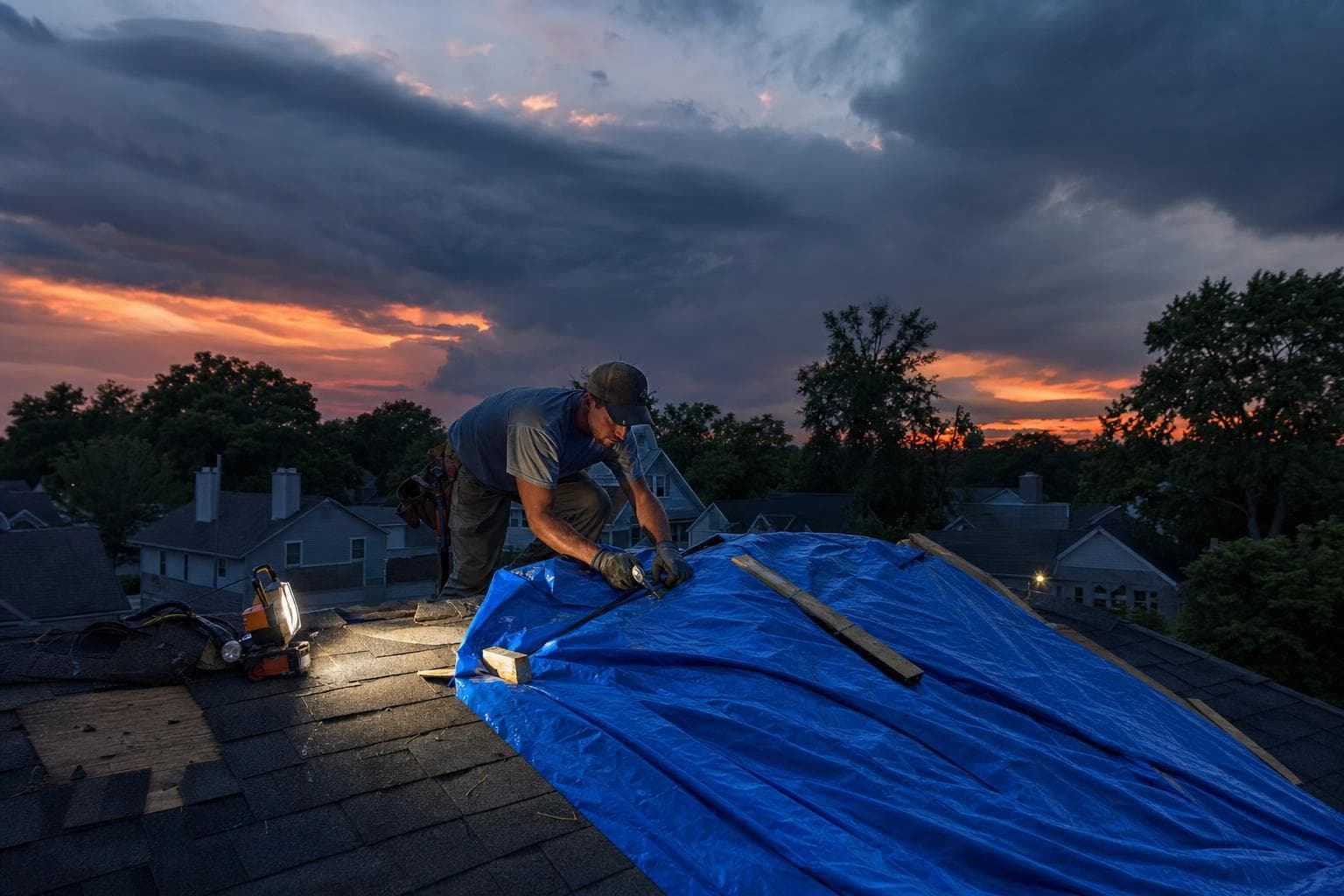
The immediate work should cover beyond the visible opening, preserve normal drainage, and remain clearly temporary. In Broomfield, the crew should account for hail impact damage and granule loss on standard shingles (very common). It should also check wind damage and uplift on exposed roof edges and ridges. The invoice should identify what was protected and what could not yet be inspected.
- Photographs before and after temporary work
- A named protected area and attachment method
- A separate date or trigger for the permanent inspection
An emergency visit is successful when the home is safer and the next roof decision is clearer. It should not force a replacement decision before the damage can be inspected properly.
How Broomfield conditions change an emergency roof response
Sitting between Denver and Boulder in the heart of Colorado's Hail Alley, Broomfield regularly takes direct hail hits from spring and summer supercells. Open terrain along the US 36 corridor also exposes roofs to strong straight-line winds.
NOAA storm reports logged 8 hail events and 4 damaging thunderstorm-wind events in Broomfield County from 2020 through 2025.
Safe access can be the limiting factor
Wind, lightning, wet roofing, unstable decking, steep access, and darkness can prevent exterior work even while water is entering. The crew should explain what can be done safely now and what has to wait for conditions to improve.
Temporary work still has to drain
A tarp or temporary seal should direct water downslope and away from valleys, walls, penetrations, and other openings. Covering the visible hole without following the drainage path can move the leak instead of controlling it.
The protected area needs a handoff
After the immediate weather passes, review the temporary work from a safe position and schedule the permanent roof and moisture inspection. Record any renewed leaking, lifted protection, collected water, or interior change rather than climbing onto the roof yourself.
Recording emergency roof work in Broomfield when insurance may be involved
Emergency mitigation and policy coverage are separate questions. Keep photographs of the uncovered condition when safe, the temporary-work invoice, the reported loss date, and the permanent estimate. The roofer documents construction and mitigation; the insurer decides whether any expense is covered.
Hail and wind claims are a recurring roofing consideration in Colorado; document the condition, compare the repair scope with the deductible, and let the insurer decide coverage under the policy.
Before choosing an impact-resistant upgrade in Broomfield, ask your insurer whether the exact product qualifies for a credit and what documentation it requires; availability and terms are policy-specific.
Before choosing a Class 4 upgrade in Broomfield, compare the exact product, installed cost difference, ownership horizon, and roof-system details, then ask the insurer whether the product qualifies for a policy-specific credit.
What Colorado law means before you authorize emergency roof work
Urgency does not make the written scope less important. Confirm the immediate work, charge, cancellation terms, access limits, and authorization separately from any later repair or replacement contract.
You can cancel if your insurer denies the claim
Colorado's residential roofing law (C.R.S. 6-22-101 et seq., originally Senate Bill 12-038) gives you two ways out of a roofing contract. You can rescind any residential roofing contract within 72 hours of signing it, and if the work is to be paid from insurance proceeds, you can also rescind within 72 hours after your insurer notifies you in writing that the claim is denied in whole or in part. When you cancel, the roofer has to return your deposit and any payments, less the cost of any materials already delivered. So you are never locked into paying out of pocket just because the claim falls through.
Your roofer can't pay your deductible, and shouldn't offer to
Under the same law (C.R.S. 6-22-105), a Colorado roofing contractor cannot pay, waive, rebate, or even promise to pay, waive, or rebate all or part of your insurance deductible on an insurance-funded job. Your contract has to state this in writing. A roofer pitching a "free roof" by eating your deductible, or quietly inflating the estimate to cover it, is steering you toward insurance fraud, not handing you a deal, so treat it as a red flag and walk away.
There is no state roofing license, so the contract disclosures matter
Colorado does not license roofing contractors at the state level, which puts more weight on the protections written into your contract. The roofing law requires a written contract that spells out the scope and cost of work, approximate start and completion dates, the contractor's contact and insurance information, and your cancellation and refund rights. The law also requires the roofer to hold your payments and deposits until materials are delivered or a majority of the work is done, rather than taking your money up front and disappearing.
Choosing an emergency roof crew in Broomfield
Because Colorado has no statewide roofing license, "licensed roofer" means little here on its own, and you have to verify the rest yourself. Roofing is regulated city by city, so confirm the company is registered or licensed in your jurisdiction and that it pulls a local permit before work begins, which is required for roofing work no matter how small the town. Ask for proof of current general-liability and workers'-compensation insurance so you are not on the hook if someone is hurt on your roof. Then check a real local track record: references, recent addresses you can drive past, and manufacturer certifications. Be especially wary of out-of-town "storm chasers" who appear right after a hailstorm, push you to sign on the spot, and offer to handle your entire claim, because the deductible and rescission rules above exist precisely to stop those tactics.
Sources: Colorado Revised Statutes, Article 22 (Residential Roofing Services; SB 12-038) · Colorado Roofing Association (state has no statewide roofing license; local licensing and permits) · Colorado Division of Insurance / DORA (action to lower homeowners rates; resilient roofs) · Colorado General Assembly, SB26-155 (Strengthen Colorado Homes; resilient roof discounts)
Emergency roof questions Broomfield homeowners ask
What counts as a roofing emergency in Broomfield?+
Active water entering the home, exposed decking, a puncture or missing roof section, fallen debris, or a condition that can worsen before normal scheduling can justify emergency help. A sagging ceiling, electrical exposure, fire, or structural movement also creates a safety issue; keep people away and contact the appropriate emergency or utility service when needed.
What should I do while waiting for an emergency roofer in Broomfield?+
Stay off the roof and keep people away from sagging ceilings, wet electrical areas, broken glass, or unstable debris. If it is safe indoors, move belongings, collect dripping water, photograph visible conditions, and note when the damage began. Do not enter an attic or touch electrical equipment when water or structural movement makes the area unsafe.
Can emergency roof work happen while it is still raining or windy in Broomfield?+
Only the work that can be completed safely should proceed. Wind, lightning, wet roofing, darkness, steep access, or unstable decking may limit exterior work, so the first response may focus on interior protection or a safe temporary measure. The crew should explain what can happen now and what must wait.
What should the first emergency roof visit include in Broomfield?+
The visit should assess immediate hazards, document the opening and interior water before covering them, install appropriate temporary protection when safe, and provide an invoice that names the protected area and work completed. It should also set a clear return plan for the permanent roof and moisture inspection.
How much does emergency roof repair cost in Broomfield?+
The 3D Roofs planning model puts an emergency protection visit in Broomfield around $350-$1,550, with a typical permanent repair around $450-$2,700 after the failed component can be inspected. Ask for the response charge, temporary materials, removal, permanent roofing, and any interior drying or restoration as separate line items.
Is an emergency tarp or temporary seal the final roof repair?+
No. Temporary protection is meant to limit additional weather entry until the roof can be inspected and repaired in suitable conditions. Schedule the permanent assessment promptly, keep the photographs and invoice, and report any renewed leaking or lifted protection from a safe location rather than climbing onto the roof.
